
The End of Online Courses As We Know Them: How AI Is Reshaping Education
 Danny Iny
Many people think online courses are failing because attention spans are shrinking or markets are saturated. In reality, they’re struggling because they were designed to deliver information – and information is no longer the scarce or valuable part of learning.
Used the right way, online education isn’t about content at all. It’s about helping people think more clearly, stay in motion, and make better decisions in a world where AI has changed what “learning” actually means.
This Article Answers
- Why online courses feel harder to sell than ever
- Which parts of online education AI is actually disrupting
- Which types of courses are becoming more valuable
- How creators should rethink their offers in an AI-driven market

Online course sales are collapsing.
Not struggling. Not “going through a rough patch.” Collapsing.
Across our own companies, and in conversations with peers and partners, we’re observing dramatic year-over-year revenue drops. Launches that used to be reliable engines of growth are now desperate attempts to break even.
Now, it’s easy enough to identify Artificial Intelligence (AI) as the culprit. But many people are overly simplifying it…
“ChatGPT killed online courses. Case closed.”
Reality is more complicated – and more interesting.
Because AI isn’t destroying online courses uniformly. So if we want to move beyond panic and polarization, we need to understand not just that the market is changing, but how it is changing.
What is actually being disrupted? And what remains indispensable?
The Real Reason People Buy Courses
To understand the disruption, we have to start with a fundamental misunderstanding. People don’t really buy online courses. They hire them.
This framing comes from Clayton Christensen’s Jobs-to-Be-Done framework. People have specific jobs they need done, and they hire products (including courses) to do those jobs. When a better, faster, or cheaper alternative comes along, they fire the old solution and hire the new one.
AI represents that new alternative for many of the jobs courses traditionally perform. But here’s what most analysis misses: the disruption isn’t uniform. It’s asymmetric. Some parts of online education are getting destroyed. Others are becoming more valuable.
For course creators, this means the path forward isn’t about wholesale panic or denial. The key is to understand exactly which parts of your business model are under threat and which parts are becoming more valuable than ever.
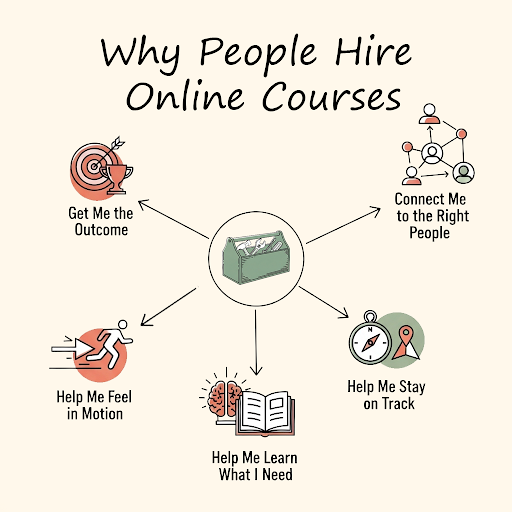
I’ve spent over a decade creating courses, and I’ve helped thousands of course creators grow their impact with educational products. And I’ve found that people hire courses for five core jobs:
- Get Me the Outcome
- Help Me Learn What I Need
- Help Me Feel in Motion
- Help Me Stay on Track
- Connect Me to the Right People
For each of these jobs, there’s a dramatic disconnect between what people think AI can do versus what it actually delivers. So let’s examine the core jobs people hire online courses to do, and how AI is disrupting each one.
Job 1: Get Me the Outcome
“I want the result. I don’t care how the sausage is made. Just help me get there.”
This is all about results. The buyer’s core desire is the external outcome. They want to achieve a transformation or solve a meaningful problem, and they see the course as the vehicle to get there.
Current State:
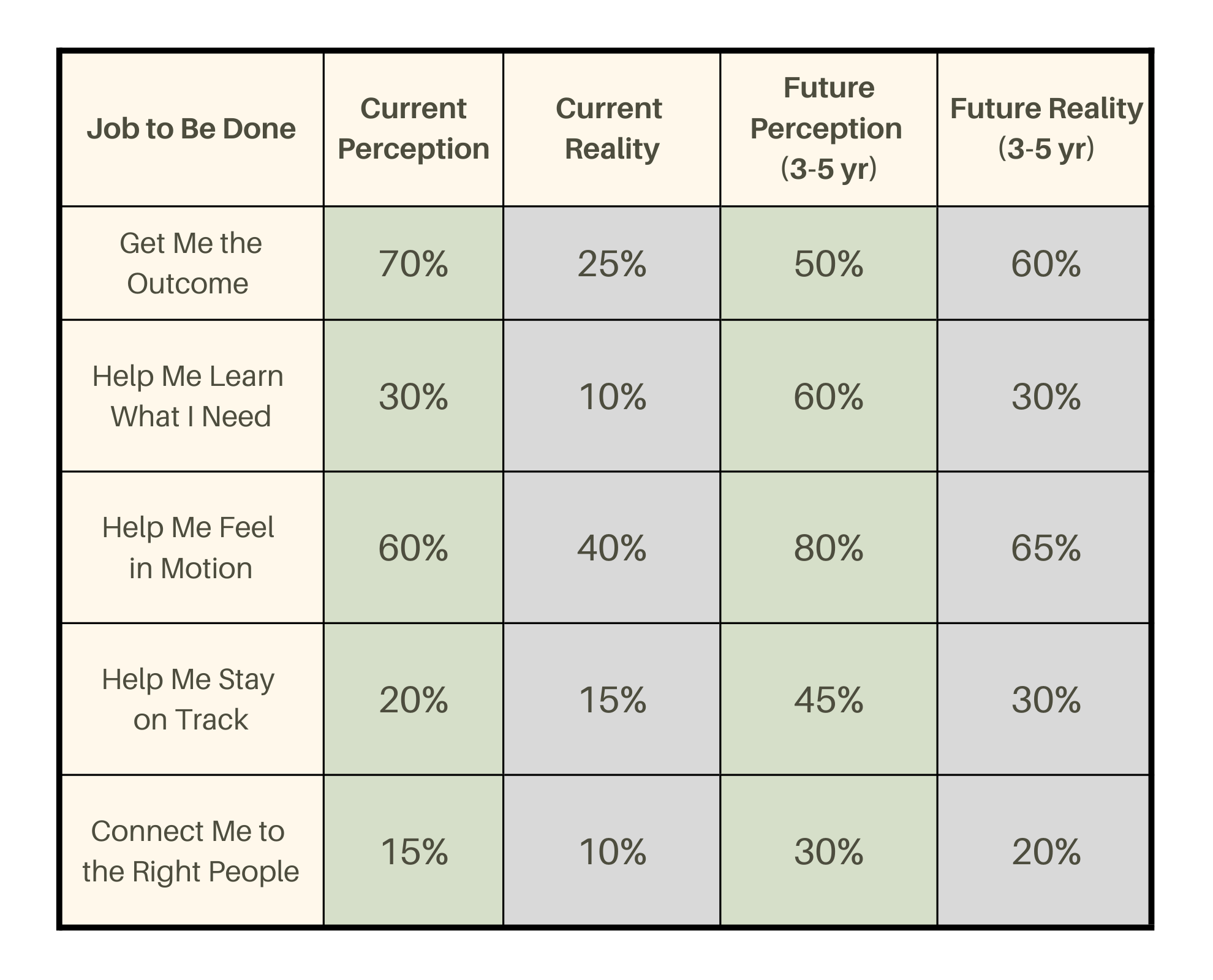
- Perception of disruption: 70% (people believe AI can deliver outcomes)
- Reality of disruption: 25% (AI easily delivers outputs)
Right now, most of the market thinks AI is magic. They see the headlines: “Write your entire sales funnel in 10 minutes!” or “Launch your course with one prompt!” And they believe it.
So instead of buying a course to help them reach their goal, they turn to ChatGPT. They ask it to write their sales page. Create their content calendar. Build their business plan.
But here’s what happens next: They get a beautifully formatted document that looks professional… and then nothing happens. Because they don’t know if the sales page is any good. They can’t tell if the strategy makes sense. They have no idea how to actually implement what AI produced.
AI gave them an output. But it didn’t give them an outcome.
Future Trajectory (3-5 years):
- Perception: Will remain high at 50%
- Reality: Will rise to 60% as capabilities increase
AI will get scary good at certain specific outcomes. Need a book written? AI will do it. Want your ads optimized? AI will handle it. Need a basic website? Done.
And that’s especially true when paired with agentic memory, multi-step reasoning, and plug-ins that handle real-world execution. But for more complex transformations (business model shifts, strategic pivots, human insight, and interaction) AI will still be limited.
Job 2: Help Me Learn What I Need
“I want competence to act independently and make good decisions.”
This is about capability-building. Buyers don’t just want the fish… they want to learn how to fish. They value understanding, skill-building, and being able to handle things independently.
Current State:
- Perception of disruption: 30% (some people believe AI teaches competence)
- Reality of disruption: 10% (most people don’t know how to learn with AI)
The perception here is interesting. Most people still think of learning as watching videos or reading modules. They haven’t figured out that AI can be an incredible learning partner – if you know how to use it.
In truth, AI is already significantly disrupting learning for self-directed, resourceful learners who know how to use it. It can break down concepts at any level, translate abstract ideas into analogies or action, walk you through practice, give feedback, and test your knowledge. It’s already outperforming most course Q&A forums, help desks, and pre-recorded lessons.
However, that’s for learners who are self-directed. Most people simply ask a question and get an answer. And AI still struggles with scaffolding the learning arc. It’s usually not great at telling the learner what matters and what doesn’t, helping them know when they’re “getting it” or not.
For most people, the real disruption curve lags significantly until AI is better able to identify gaps and adjust paths. Learning with AI is a meta-skill, and people will need to be trained to do it well.
Future Trajectory (3-5 years):
- Perception: Will rise to 60%
- Reality: Will reach 30%
AI will get much better at teaching, especially for technical skills. And as people experience AI as a competent and convenient learning companion, perception of disruption in this job will rise. Tools like ChatGPT will integrate with tutorials, simulations, spaced repetition, and other learning methodologies.
This is especially true in skill-building domains like copywriting, strategy, design, logic, and tech tools. These are areas where practice and feedback loops can be automated or semi-automated. And they’re low-hanging fruit for disruption.
But human learning still benefits from social mirroring, deep reflection, and emotional support. In values-based or identity-based work, human facilitation will remain essential.
Job 3: Help Me Feel in Motion
“I don’t want to be stuck anymore.”
This is a psychologically-driven job. The user is often not looking for clarity, competence, or even immediate results. This person is tired of spinning their wheels. They need to feel like they’re making progress, even if it’s small. And the course is their way of breaking free from paralysis.
Current State:
- Perception of disruption: 60% (People feel like they’re getting things done.)
- Reality of disruption: 40% (Their progress is often a mirage.)
AI is incredible at making you feel productive. You’ll find plenty of examples like “I built a lead magnet in 5 minutes!” or “I created a year’s worth of content this weekend!”
But it’s also dangerous. Because that burst of activity rarely translates to real progress. Users get a quick dopamine boost from quickly generating outputs. And the temporary high makes the crash worse. You felt so productive on Saturday when AI helped you create all that content. By Tuesday, when nothing has changed, you feel more stuck than before.
For stuck learners needing to start, AI can spark that initial momentum. But sustained movement requires accountability.
Future Trajectory (3-5 years):
- Perception: Will rise to 80% (AI becomes the default “quick fix”)
- Reality: Will reach 65% (The actual progress is still slow.)
AI will become everyone’s go-to for feeling unstuck. Need to feel like you’re doing something? Ask AI. Want that hit of productivity? Generate some content.
So the perception of disruption here will likely increase as AI becomes even more ubiquitous, easy to interface with, and integrated into daily workflows. People will also become more fluent in how to learn with AI (not just asking it stuff).
Still, AI will struggle to address the deeper psychological drivers of feeling stuck: fear, identity conflicts, lack of confidence, etc. And the scaffolding to maintain motion once initiated will remain a human strength.
Job 4: Help Me Stay on Track
“I know what I want, but I won’t follow through on my own”
This is a behavioral scaffolding job. The buyer isn’t confused about what they want, and maybe not even about what they need to do. The problem is execution over time: consistency, focus, and follow-through.
But this job isn’t just about accountability in a formal, structured sense. It’s about being held inside a container that reinforces forward motion over time. That container might be:
- A structured timeline with weekly releases or timed curriculum
- A shared journey where a cohort moves through the material together
- A peer environment like a Slack group or community forum
- Live calls where you show up and do the work
- A coach who actually cares if you succeed
The common thread isn’t the format. It’s that there’s something external that helps you keep your commitment.
Current State:
- Perception of disruption: 20% (some people believe AI provides accountability)
- Reality of disruption: 15% (it doesn’t actually work for many people)
Most people don’t yet see AI as a stay-on-track mechanism. But that’s starting to shift with AI journaling assistants, planning tools like Notion AI or Reclaim.ai, and ChatGPT used as an accountability partner or decision aid.
The perception today is still niche, but it’s growing. And there’s an underlying problem: it’s easy to ignore AI reminders. People do it all the time, because when you skip your AI check-in, nothing happens. The AI doesn’t care. There’s no disappointment, no social cost, no real consequence.
Granted, some advanced users are already self-structuring with AI, using self-reflective coaching loops. So for high-agency users, AI is beginning to hold the job of staying on track, but only partially.
Future Trajectory (3-5 years):
- Perception: Will rise to 45%
- Reality: Will reach 30%
AI will get better at the mechanics of accountability – tracking, reminding, nudging. But it will struggle to simulate shared time, collective commitment, and the energy of human presence.
Without being tied to real relationships, AI cannot hold the nervous system through friction, distraction, or fatigue. So the true disruption ceiling is lower than many expect, especially for emotionally sticky or identity-reinforcing programs.
Job 5: Connect Me to the Right People
“I want to belong (or be near someone who matters).”
This merged category combines affiliation and access. Sometimes it’s about finding your tribe – people who get you, who are on the same journey. Other times it’s about proximity to someone you admire, someone who can open doors.
Current State:
- Perception of disruption: 15% (few people believe AI can provide connection)
- Reality of disruption: 10%
Almost no one thinks AI can replace human connection. We all understand, at a gut level, that talking to AI isn’t the same as talking to a person.
AI can introduce you to ideas, draft your outreach emails, or prep you for meetings. But it can’t introduce you to the right person. It can’t vouch for you. It can’t create the electricity of being in a room (virtual or physical) with people who share your ambitions.
Future Trajectory (3-5 years):
- Perception: Will rise slightly to 30%
- Reality: Will remain low at 20%
As AI becomes more conversational and “personality-driven,” some people might start to feel connected to it. (This is already happening.) But even with emotional modeling and memory, AI will still lack reciprocity and status transfer. People form para-social bonds with AI agents, but that’s not the same as being connected to actual humans.
AI may eventually be perceived as a connector, but not as the relationship itself. That means courses that include connection as a key component have little to fear from AI.
The Bigger Picture
So the full picture looks something like this:
And the disruption risk varies dramatically by the type of course and its primary value proposition:
Very High Risk:
- Low-ticket courses sold primarily on momentum messaging (“Just start!” “Get unstuck!”)
- Pure information products without implementation support
- Courses that promise quick outcomes without skill-building
- Self-paced courses with no community or coaching component
These courses compete directly with free AI, which provides the same dopamine hit of “starting something” and can generate similar information instantly.
Moderate Risk:
- Mid-priced tactical skill-building courses (copywriting, Facebook ads, webinar strategy)
- Courses with basic accountability features (weekly check-ins, progress tracking)
- Programs that teach specific methodologies or frameworks
- Hybrid courses that mix self-paced content with occasional group calls
These maintain some value but face pricing pressure as AI handles more tactical instruction. They survive only if they differentiate through proprietary methods, superior pedagogy, or relationship-driven support.
Low Risk:
- High-touch coaching programs with significant human interaction — though the question of whether coaches need an all-in-one platform or a focused stack matters here too.
- Community-centered programs where peer connection is the primary value
- Mastermind and inner-circle offers focused on access and proximity
- Transformation programs addressing identity, values, or deep behavioral change
- Certification programs that confer status or credibility
These programs leverage uniquely human elements – belonging, mentorship, accountability through relationship, and social capital – that AI cannot replicate.
Course platforms designed for this kind of high-touch delivery – like Ruzuku, which is built around cohort-based courses, threaded discussions, and step-by-step learning paths – are well-positioned for this shift.
What This Means for Course Creators
The disruption pattern is clear: AI is most effective at delivering information and quick hits of momentum. And it’s weakest at providing genuine accountability, building real competence, and facilitating human connection.
Course creators who understand these dynamics – who can see both what’s being disrupted and what remains defensible – can position themselves to thrive in the AI era. But those clinging to old models, especially those built primarily on information delivery or momentum generation, face an existential threat.
The market is already voting with its dollars. Pure information products are dying. High-touch, relationship-driven programs are holding strong. The middle is getting squeezed.
Understanding this pattern is crucial. But knowing what’s happening isn’t enough. In the next post, we’ll explore the strategic playbook: how successful course creators can restructure their offers, reposition their value, and build business models that thrive in the AI era.
Because the question isn’t whether to adapt… it’s how.
The Core Takeaway
Online courses aren’t becoming obsolete, but the way many of them are built is.
AI doesn’t make education less valuable. It makes information less valuable.
When courses rely on content alone, they become easy to replace. But when they help people think, stay in motion, and make better decisions, they become indispensable.
The future doesn’t belong to those who produce more material. It belongs to those who remove the friction that keeps people from making real progress.
Want to go deeper on this? Inside the free AI Strategist Quickstart, we explore how to use AI as a thinking partner – not a shortcut – so you can move from information to transformation without losing clarity or momentum.
about author
Danny Iny
Danny Iny is the founder of Mirasee, a 6x best-selling author, and an entrepreneur who helps coaches, consultants, and experts build businesses that are both profitable and purpose-driven. He’s best known for showing people how to package their expertise into premium offers, attract the right clients, and grow thriving businesses that make a real impact.
Read more posts by Danny Iny