
What’s Really Going On When AI Frustrates You
 Danny Iny
AI can feel remarkably powerful one moment and deeply frustrating the next. Usually both at the same time. Most of that frustration traces back to five common mistakes in how people think about what AI is actually doing — and once you see them, the confusion mostly clears.
This Article Answers
- Why does AI feel powerful sometimes and useless other times?
- Why can’t AI remember what you told it in a previous conversation?
- How does AI actually generate answers — and why does that matter?
- What does it mean to stay in charge of your own thinking when using AI?
My book AI Curious came out a few weeks ago. Since then, I’ve seen a handful of the same questions popping up.
Why does it keep making things up?
Why doesn’t it remember what I told it last week?
Why is what it gives me so generic, when everyone else seems to be getting more interesting stuff out of this than I am?
Am I cheating?
What’s all the fuss about?
This is just a sampling of the questions that smart people are asking. Because it’s genuinely confusing – AI sometimes feels uncannily powerful, and sometimes is just weirdly frustrating. Often it’s both – at the same time!
And there are a lot of different questions, but they all trace back to a small number of mental model errors. Fundamentally, most people are working with a distorted picture of what AI is doing, and an incomplete picture of where their own work in the conversation begins and ends. Which is actually good news, because once you see the errors, most of the questions answer themselves.
What follows is a more tactical look at the common missteps people make with AI. Think of it as a quick-reference cheat sheet. My AI Curious book covers the full picture, and I hope you’ll grab a copy – but if you need a quick answer and some orientation right now (or something that you can send to a colleague before they ask the same thing for the fifth time) – this cheat sheet is for you.
1. AI Is Not a Search Engine
Most complaints I hear about AI trace back to one habit. People are still treating it the way they’ve treated Google for the last twenty-five years. Type a query, take the first answer, move on.
This is the deepest of the five errors, because most of the others descend from it. AI isn’t a search engine, and it doesn’t behave like one. Search engines hand you an answer. AI works more like a conversation that you have to keep going. If you treat it like Google, the answer comes back shallow, and you miss the real power of the tool. The really valuable parts tend to show up at the second or third question – not the first.
People who tell you to “use AI as a thinking partner” are trying to point out this error. And there’s a real point to that idea, but I’ve come to realize that framing AI as a thinking partner is itself a trap, which I unpack in The AI Thinking Partner Lie. But for now, what matters is the behavior that the phrase is pointing to.
Here’s a simple rule of thumb: the first answer is the start of the conversation, not the end. Better prompts rarely turn a thin reply into something useful. What does is the follow-up – the question that pushes back on what came back, or asks what got left out, or tells the model what you actually meant once you’ve seen what it thought you meant. The first answer reflects the average way your question could have been asked. The follow-ups reflect the specific way you asked it. That’s where the useful answers live.
2. Why AI Doesn’t Remember the Way a Person Does
Imagine you had a long work meeting last Monday. On Friday you run into your colleague at a coffee shop and ask what they thought about some specific detail you discussed. They likely left their notes back at the office, so they might remember the topic, who said what at a broad level, maybe even an important idea that stuck. But they can’t reconstruct the specifics without the notebook that has all the meeting notes.
AI works in a similar way, only more so. The model holds onto past conversations only as a fuzzy outline. It knows roughly what you tend to work on and what you’ve told it about yourself, but the specifics blur. (And this is assuming that you even have memory turned on in the first place.) Ask it to quote a particular past chat word-for-word and it can’t. When you ask “do you have access to that chat from last week?” the honest answer is no. The model often won’t say so, though. It’ll bluff, because it’s trained to be helpful.
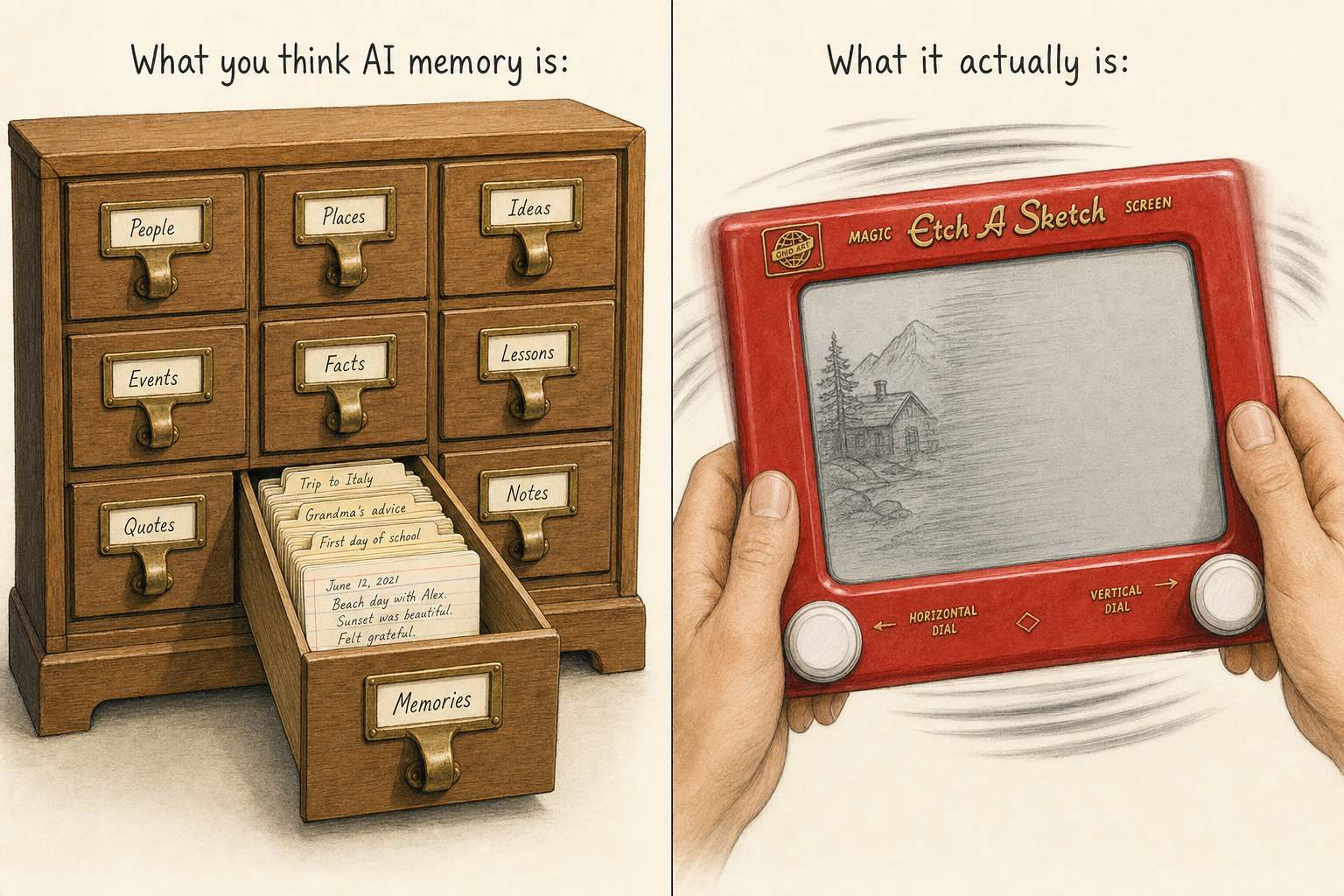
Even within a single conversation, you hit a different version of the same problem. Long threads degrade. Around 25,000 to 30,000 words in, depending on the model and the moment, the model starts to lose the thread. It gets sluggish, forgets earlier instructions, and a few exchanges later it’ll contradict something it said before. People often experience that as the model getting dumber. But it’s really just the architecture hitting its limits.
So manage context actively. Re-establish what you’re working on at the start of an important thread. Copy out anything worth keeping. When you start fresh, drop the relevant context back in. Continuity is your job, not the tool’s.
That’s the architecture, not a bug to work around. Treat it that way and the memory questions stop being mysteries.
3. Why AI Doesn’t Actually Know What It’s Doing
When you ask a person a question, there’s a split-second before they answer where they do an internal knowledge check. Depending on what it returns (and how honest they are), they might say “I don’t know” or “I think it’s X, but I’m not sure.” Either way, something happens inside their head first. They start by consulting what they know.
AI doesn’t do that. The model generates text by predicting the next word that statistically fits, and then the next, and the next, based on patterns in its training data. There’s no reasoning happening underneath, and no internal sense of whether the prediction is on track. When the prediction matches reality, the answer is right. When it doesn’t, the answer is wrong. And the model has no way of telling the difference.
This shows up in a surprising way when you ask the model about itself. You might expect (logically) for it to be an expert on itself. But say “can you do X?” and the model isn’t introspecting, or running any kind of self-check. It’s just predicting what an answer to that question usually sounds like. Sometimes the prediction lines up with what the model can actually do, but more often it misses, sometimes by a wide margin. So the model often gives its most unreliable answers, ironically, when it’s talking about itself.
Hallucinations come from the same machinery. The model doesn’t know when it’s making things up, because truth and lying aren’t concepts that exist inside it. It’s just generating text that sounds like the right answer would sound. Sometimes the text is true, and sometimes it’s wrong, and the model has no way of knowing which is which. That’s why telling the model not to lie to you doesn’t work. It can’t act on that instruction because it doesn’t know whether or not it’s lying. A more useful instruction might be to ask it to cite the specific source for any claim, and to flag anywhere there’s uncertainty or ambiguity about underlying facts. Those instructions work because the output is verifiable. Either the source is real or it isn’t, and either the flag is there or it isn’t.
4. It Optimizes for Attention, Not Outcomes
Algorithmic feeds all run on the same logic, whether it’s YouTube’s autoplay, Instagram’s scroll, or TikTok’s “For You Page.” Each one is built to keep you in the seat by predicting what’s most likely to hold your attention next. AI chatbots run on the same logic, applied now to a tool you use to think.
This isn’t a conspiracy. Nobody on the other end is trying to manipulate you. The system just has its own incentives, and those don’t always overlap with yours – and the gap shapes the output in ways that aren’t always obvious.
Once you start looking, the tells are everywhere. Every response wants to hand you the next deliverable, whether you asked for one or not. Long answers tend to end with the line about something most people miss. Short answers end with follow-up questions to keep the conversation going. The praise shows up everywhere too, on questions and observations that don’t really merit it (“what a great question,” “thank you for that nuanced point”). All of it comes from the same place: the tool was built to keep you engaged, which isn’t quite the same as getting you the outcomes you’re after.
Most of the time, the two overlap. You get something useful and stay for another round. When they pull apart, though, the model goes with engagement. Not maliciously. That’s just where the training pressure pointed.
Which means if you’re not actively supervising the conversation, you’re being shaped by it. Not in a dramatic way. Structurally. The conversation drifts toward what keeps you there, and the difference between what keeps you there and what serves you accumulates one exchange at a time.
5. The Thinking Has to Stay Yours
Sitting down with AI makes it tempting to treat the tool like a worker. Write the prompt, receive the output, move on. But you’re not just using a tool. You’re also supervising it – watching for drift, and deciding when an answer is good enough to stop. Both roles are yours, and the model can only do the first one.
Prompts are useful at first. They help you get started and cover the important bases. But they’re more crutches than scripts, and eventually you outgrow the template. You can ask for what you want without it, and course-correct when the response is off. A good prompt without supervision is brittle – it might work sometimes and break others. Weaker prompts with active supervision usually go further.
Step back from all of that, though. The deeper test is simpler. Did you think this through, with the tool helping you do the thinking? Or did you outsource the thinking and clean up what came out? Those are different things, and most people know which one they did when they’re honest with themselves.
That same test also dissolves the disclosure question. People keep wondering whether they should tell others they used AI for an asset they created (an essay, an image, a guide, etc.) – but that’s the wrong question. The question is, did the work come from you? If it did, no disclosure is owed; nobody discloses they used Word or Photoshop. And if the work didn’t come from you? Then disclosure doesn’t fix anything. The work is still slop, and people will smell it.
The principle is straightforward, even if the practice isn’t always easy. The tool can do a lot, but it can’t do the part that matters most – and that part is yours.
Back to the Same Root

All five misconceptions trace back to context. AI’s output is only as good as the context you bring to it, and each error is a different way that context breaks down.
You never build it in the first place, because the first answer ended the conversation (the search-engine misconception).
Context doesn’t persist between threads, because the tool can’t hold past chats the way you assumed (the memory misconception).
The model misreads the context you’ve given, bluffing about its own capabilities (the introspection misconception).
The system shapes the context without your noticing, steering toward what holds your attention (the attention-optimization misconception).
And once you hand off the supervisor role, the context stops being curated entirely (the judgment misconception).
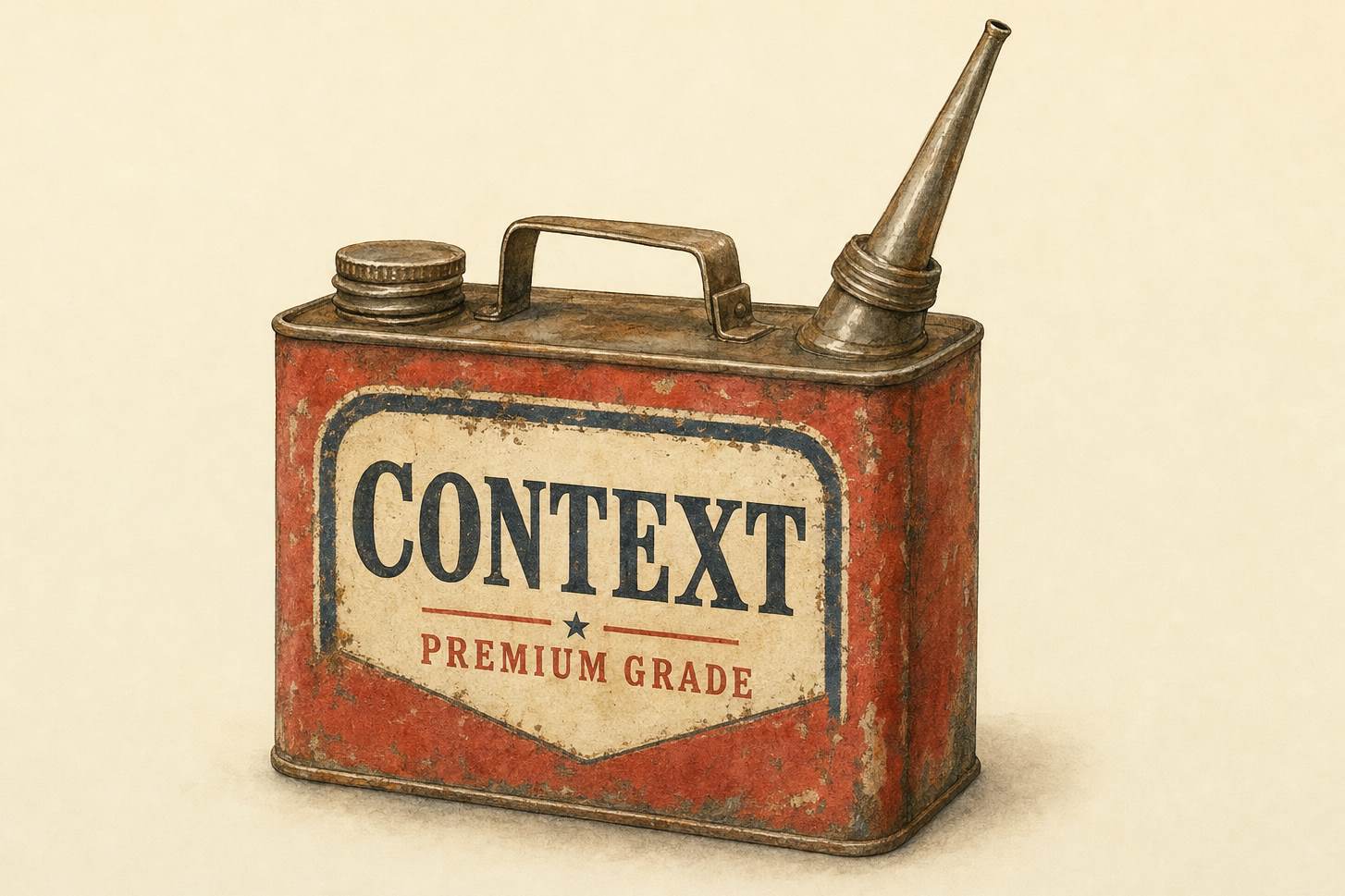
Trace the errors back to that root, and the corrections fit together. Context is the fuel: everything else is plumbing.
Core Takeaway
AI’s output is only as good as the context you bring to it. Most frustration with the tool traces back to five misconceptions about what it is and how it works — and fixing those misconceptions doesn’t require better prompts. It requires a clearer picture of what you’re actually doing when you sit down with it.
AI Curious is Danny Iny’s book on learning to think clearly with AI — not as a productivity tool, but as a genuine thinking partner. It’s available now on Amazon.
about author
Danny Iny
Danny Iny is the founder of Mirasee, a 6x best-selling author, and an entrepreneur who helps coaches, consultants, and experts build businesses that are both profitable and purpose-driven. He’s best known for showing people how to package their expertise into premium offers, attract the right clients, and grow thriving businesses that make a real impact.
Read more posts by Danny Iny