
How to Use AI Without Losing Your Genius (Why Most Experts Get It Wrong)
 Danny Iny
Most people get disappointing results from AI because they’re using it to shortcut the work of producing content instead of doing the harder work of thinking. Used the right way, AI isn’t a content machine at all – it’s a thinking partner that removes friction from strategy and sharpens your judgment.
This Article Answers
- Why does AI-generated content feel generic for so many experts?
- What’s the difference between using AI as a shortcut versus a thinking partner?
- How should experts use AI to deepen their thinking instead of outsourcing it?

I was an early adopter of AI, but not an enthusiastic one.
If I’m being honest, I felt a sense of resentment.
It felt like an obligation – another shiny, distracting object pulling focus from the real work of strategy and service. But I dove in as it became clear how thoroughly it would reshape the world of expert-led businesses.
I talked to the experts, tracked the emerging use cases, and even wrote a book on the topic. My early results only deepened that feeling of resentment.
The outputs were gimmicky. The tone was always slightly off, and the ideas were painfully generic. It was like talking to an incredibly well-read intern who had memorized every business book ever written but possessed zero real-world experience.
Sure, the speed felt like magic at first. But then you’d read what it produced, and it was just disappointing. So the magic would fade, and you’d be left with something that wasn’t just unusable, but that had somehow taken you further away from the clarity you were seeking.
I found myself thinking, “Is this it?”
A lot of people I’ve talked to felt that way… drawn in by the promise of a revolutionary new tech tool but let down by the mediocre outputs. That’s one of the single biggest reasons most people have failed to truly leverage it.
They’ve been handed a flawed model, treating AI as a glorified content vending machine: you put in a prompt, you get a piece of content out.
And when that content is bland, soulless, and indistinguishable from the flood of other AI-generated material, they figure the machine is broken and move on.
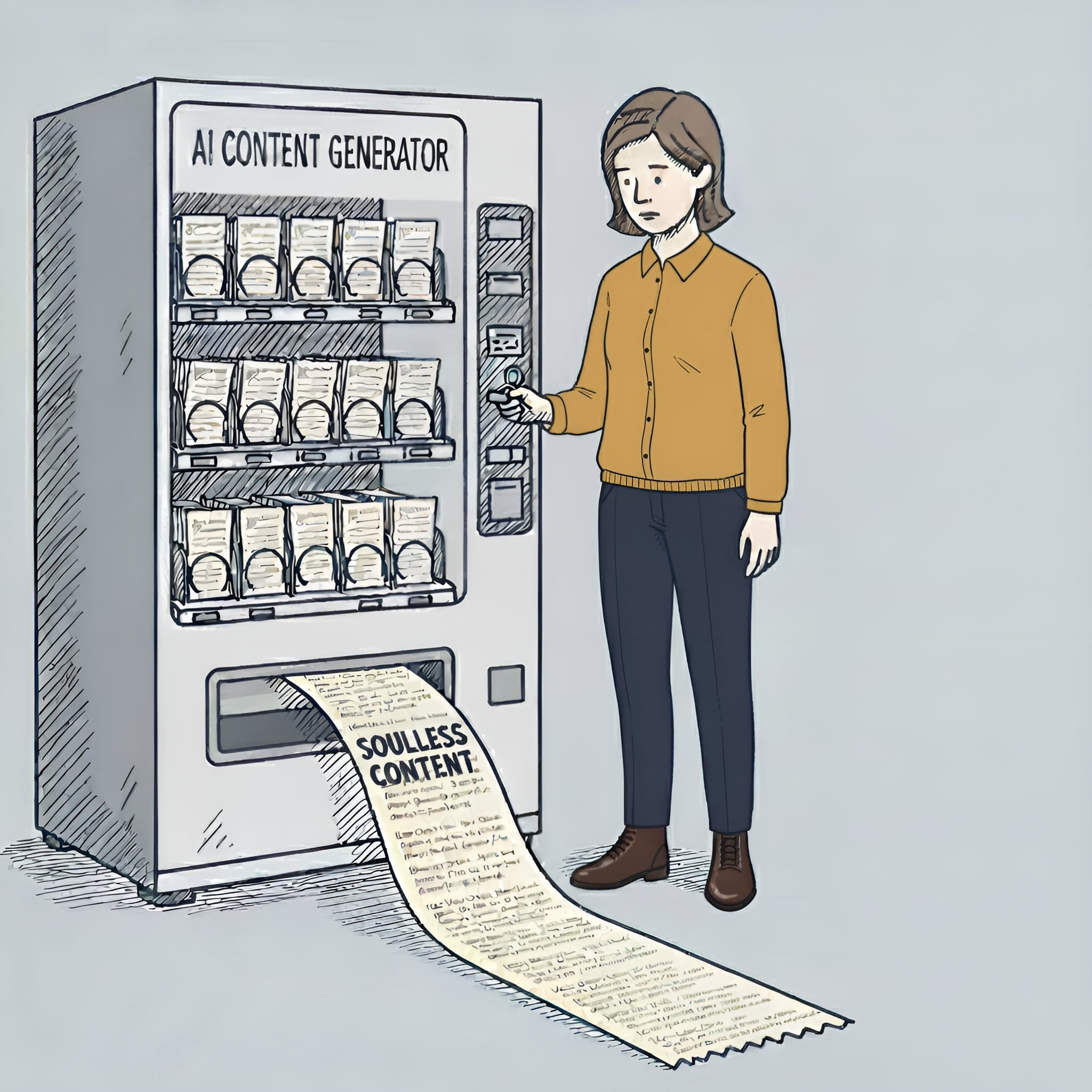
But they’re wrong. The machine isn’t broken. We’re just using it for the wrong thing.
Why Creating More AI Content Is No Longer an Advantage
When generative AI first hit the mainstream, the immediate advantage was obvious: speed and volume.
If your competitors were writing content the old-fashioned way, you could use AI to generate ten times the output in a tenth of the time. For a brief moment, you could apply a “flood-the-zone” strategy, overwhelming the market with the sheer quantity of your output.
That advantage lasted for about fifteen minutes.
Because the means of production have been democratized. And an edge built on speed and volume only works until everyone else figures out they can do the same thing.
It’s as if everyone in a crowded room was suddenly handed a megaphone. The initial advantage goes to the first person who gets one. But once everyone has one, the solution isn’t to shout louder. That just adds to the cacophony, and the room becomes an unbearable wall of noise.
This is what’s happening online right now.
Everyone can flood the zone, and they are. So the marketplace is drowning in a tidal wave of generic, AI-generated blog posts, social media updates, and marketing emails.
Using AI like everyone else doesn’t make you stand out anymore. It just buries your signal in an ever-rising ocean of noise. And worse, it actively degrades your brand by associating it with low-value, undifferentiated content.
So the only way to stand out is by leaning into your personal genius – the stuff that is uniquely you.
Your hard-won insights. Your proprietary frameworks. Your unique voice and worldview.
The problem is that these are the very things that AI, on its own, cannot possibly replicate. Yet that’s what most people are trying to outsource to AI.
They’re trading their distinctiveness for a temporary hit of efficiency. They are solving for the wrong problem, and it’s a race to the bottom that ends in complete commoditization.
Fortunately, there’s a way out.
A New Approach to AI: From Time-Saver to Time-Expander
One approach is to simply abandon AI altogether. But that’s a mistake.
It would be like trying to ignore the internet twenty-five years ago. Or pretending that electricity wouldn’t change everything a hundred years ago. The way out isn’t to abandon the tool. It’s to reframe its purpose.
Because AI is not a content vending machine… it’s a context engine.
This reframe begins with a crucial change in mindset. Most people approach AI with a time-saver mentality. Their thinking is rooted in scarcity: “I don’t have enough time, so how can I use this tool to cut corners and get this done faster?”
This inevitably leads to shallow prompts and generic results.
The real unlock is to stop seeing AI as a time-saver and start seeing it as a time-expander. The goal is not to do work in less time. Instead, the goal should be to accomplish exponentially more – at a much higher level of quality – with the time you were going to allocate anyway.
Imagine you go to the gym for an hour, three times a week. The time-saver approach is like trying to replace your gym time with a seven-minute workout. It might be better than nothing, but it won’t deliver real results.
The time-expander approach means you still spend that hour at the gym. But now, you get more done in that hour. And just as important, it feels effortless, even though you’re coming out three times as ripped.
Because when you use AI in the way I’m talking about, it literally feels like time is bending. Instead of cutting corners, you’re collapsing weeks of deep, strategic thought into a single, focused afternoon.
You spend less energy and time but gain more clarity in the process, and it has a cascading effect on your business.
The AI Clarity Cascade: A Process for Deepening Strategic Thinking
Despite my early experiments with AI, I actually stumbled upon this by accident.
For years, I’d had a persistent health issue that a series of doctors couldn’t solve. Each visit felt the same: a brief, 15-minute consultation where I’d try to summarize years of history while a clock ticked in the background.
My frustration grew with each unresolved appointment.
Out of desperation, I turned to AI. I gave it a role: a panel of medical experts from every relevant discipline – half of which I’d never heard of. Then I gave it a task: interview me, one question at a time, until you have everything you need.
Over the course of days, I got questions and responded using voice input, pouring out every detail, memory, and frustration without filtering.

The exploration was fascinating. It wasn’t necessarily that AI was “smarter” than the doctors. The difference was a shift in constraints. Because with human experts, additional context is expensive. It costs their time, their energy, and your money. The entire system is designed for efficiency, not depth.
But with AI, the cost of incremental context is zero.
You can always dig a little deeper. You can always follow one more thread. You can always add another round of exploration without it getting tired or annoyed. That’s why it was able to help me pinpoint my issue.
And this realization unlocked a new rhythm of interaction, a recursive loop of thinking I now call the AI Clarity Cascade.
Instead of trying to find one magical prompt, I created a rigorous, four-phase process.
Phase 1: Provide Context
This is the foundation. You start by feeding AI everything you know about a situation.
But you don’t just give it facts, you give it the raw material of your thinking. Your goals, your fears, your values, your voice, your half-formed ideas, your nagging doubts.
I find the best way to do this is with voice input – specifically the microphone icon for “dictation” mode in ChatGPT. I don’t use the full “voice mode” where it speaks back to you because I find that annoying and not very good for deep work.
With dictation, though, it bypasses the internal editor that organizes and sanitizes your thoughts when you type. You want to give it a stream of consciousness, not a polished report.
In this phase, you’re loading the engine with the fuel of your unique perspective.
Phase 2: Get a Reflection
This step is critical and almost always skipped. You ask AI to reflect back what it has understood, but in a synthesized form:
“Summarize the key objectives, constraints, and underlying tensions you’ve heard from me so far.”
Yes, this a check for accuracy, but it’s also a coherence check. It forces AI to move beyond simple pattern-matching and begin structuring the information into a cohesive model.
It’s in this step that you start to see your own thinking more clearly, mirrored back to you.
Phase 3: Deepen the Context
At this point, you’re moving beyond the basic information gathering.
You ask, “Now, what additional questions do you have for me to better understand my situation?”.
This turns AI from a passive recipient of instructions into an active collaborator.
It will start to probe your assumptions and ask questions that reveal your own blind spots. It might ask, “You’ve said your goal is X, but you’ve also expressed a strong value for Y. Have you considered the tension between these two?”.
Suddenly, it’s much, much more than a tool… it’s a Socratic partner.
Phase 4: Synthesize an Insight
Usually, people want to jump straight to this step, because they see AI as a solution machine.
But only after a deep, iterative layering of context do you ask it to help you solve the problem:
“Given everything we’ve discussed, help me architect a strategy,” or “Draft an outline for this project.”
By this point, the “ask” is no longer a shot in the dark. It’s the logical conclusion of a deep, collaborative diagnostic process. And the quality of the final output is a direct result of the rigor of the preceding three steps.
This process transforms AI from a passive tool into an active thinking partner.
My wife and business partner, Bhoomi, articulated it perfectly after watching my process:
“When I work with my AI, it feels like a junior VA. When Danny works with his, it feels like a senior strategist.”
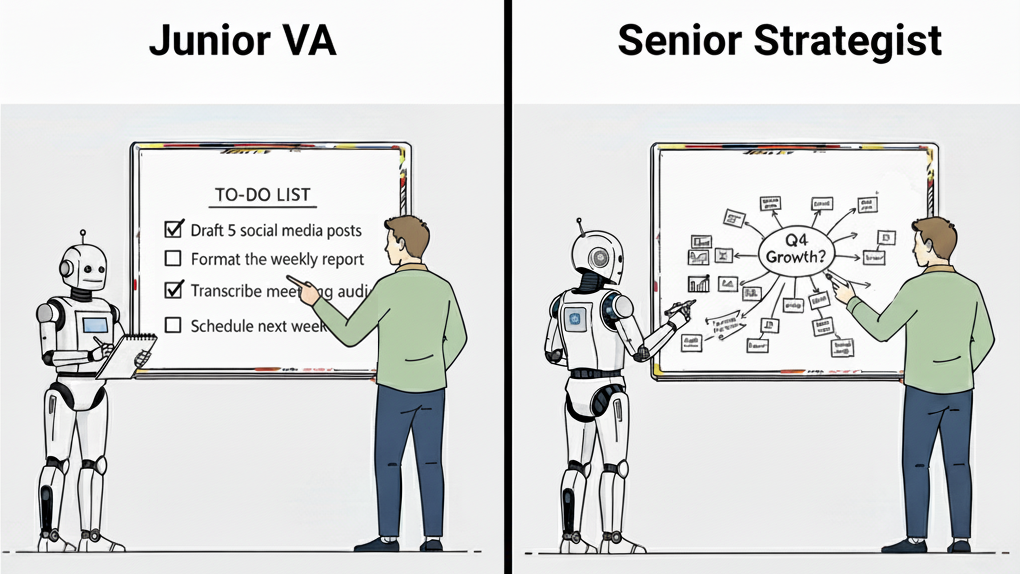
A junior VA needs explicit, step-by-step instructions and constant supervision. A senior strategist understands the deeper context. So it can challenge your thinking, offer new perspectives, and co-create solutions.
Used this way, AI doesn’t replace your genius. It removes the invisible constraints that have been holding it back. The friction of getting started, the time it takes to organize your thoughts, the tedious work of structuring a first draft… that all dissolves.
So you can stop wasting energy on the mechanics of thinking. Instead, you spend more time and energy on the thinking itself.
You become more you.
Should You Outsource Your Thinking to AI or Collaborate With It?
Right now, we’re at a fork in the road…
One path is to use AI to outsource your thinking. This is the path of AI laziness.
It’s asking it to do the work for you because it’s fast and easy. And while many people are choosing this path, it leads directly to what researchers have called “cognitive atrophy.”
An MIT study found that students who used ChatGPT to write papers used their brains significantly less than those who used traditional methods. The neural pathways associated with critical thinking, synthesis, and originality simply didn’t fire.
By using AI to replace your thinking, you’re choosing to be a character in your own story, passively reacting to outputs.
You are literally training your brain to be less intelligent.
The other path is to use AI to augment your thinking. This is the path of the Clarity Cascade.
It requires more effort up front, but the payoff isn’t just a better output. Because the real training isn’t for the AI… it’s for you.
You develop the habit of thinking more deeply, questioning your assumptions, and exploring problems from multiple angles. And while it uses AI as a partner, this path keeps you as an active author, directing the plot of your work. It makes you a sharper, more rigorous strategist.
Nearly everyone is stuck on the first path, using AI as a shortcut and wondering why the results are so disappointing.
That gives you a massive advantage. While they are producing noise, you can create a signal.
So stop asking AI to think for you. Start asking it to think with you.
Instead of treating it as an intern that you assign tasks to, train it as a strategic partner… one that gives you more clarity, judgment, and leverage.
The Core Takeaway
AI doesn’t make you replaceable – using it lazily does.
But when you stop asking AI to think for you and start using it to think with you, it removes the friction that gets in the way of good judgment.
When you use AI this way, you don’t lose your voice or your edge.
You remove what’s been getting in the way of them.
Want to go deeper on this? Inside the free AI Strategist Quickstart course, we help experts use AI to think more clearly and make better strategic decisions.
about author
Danny Iny
Danny Iny is the founder of Mirasee, a 6x best-selling author, and an entrepreneur who helps coaches, consultants, and experts build businesses that are both profitable and purpose-driven. He’s best known for showing people how to package their expertise into premium offers, attract the right clients, and grow thriving businesses that make a real impact.
Read more posts by Danny Iny