
How to Make Confident Business Decisions When You Don’t Have All the Answers
 Danny Iny
The more you understand about a complex situation, the harder it gets to act. That’s the strategist’s paradox. But there’s a way through it, and it doesn’t require more information, better predictions, or waiting for certainty that will never come.
This Article Answers
- Why does gathering more information sometimes make decisions harder?
- What is a core thesis and how does it help you act under uncertainty?
- How do you know what to pay attention to and what to ignore?
- What is the difference between conviction and certainty?

A little over a year ago, I retired our entire product catalog. I didn’t refine it or update it. I retired everything we’d built around creating and selling online courses – fifteen years of programs, products, and infrastructure.
I made that choice because I could see the market shifting in multiple directions. AI was changing how people learned. The old course model was collapsing. And I had come to see that an online course isn’t actually the best starting point for most experts.
I could also see new opportunities – better ways to serve our audience with more integrated approaches. It was a tough call. There were good arguments on both sides, and I couldn’t see with complete clarity which direction was right. There was a reasonable case for keeping the products and building new ones alongside them. And there was a reasonable case for letting them go because they represented who we were, not who we were becoming.
But that’s the entrepreneur’s job – making decisions when you can’t know everything. In another essay, I described the three levels of awareness – the Blind, the One-Eyed King, and the Strategist.
The Blind basically keep their head down, and they’re not aware of what’s going on. The One-Eyed King sees one trend clearly and acts with conviction, which works until the landscape shifts in ways they didn’t anticipate. The Strategist sees multiple dimensions, intersecting trends, second-order effects. It’s a more informed and wiser position, but it’s also filled with doubt and paralysis. You see so much complexity that it can be hard to act.
So the question is: How do you see the intersections and still make decisions?
Why More Information Makes Decisions Harder, Not Easier
Ben Horowitz writes about this in The Hard Thing About Hard Things. As a CEO, you’re constantly making decisions with incomplete information. You might be 70% sure you should go one way and 30% sure you go the other way. But you can’t actually go 70% in one direction and 30% in another. That just tears you apart.
So your decision has to be binary, even when your certainty is not.
This creates a real challenge for the Strategist. The One-Eyed King acts with certainty because they don’t see the other dimensions. But the Strategist sees five paths, three major risks, a dozen ways the landscape could shift.
Most people think the answer is to gather more data, to model more scenarios, to wait for clarity. But this doesn’t work. More information reveals more complexity, and that just lowers your confidence even more.
So if you can’t achieve certainty, and you can’t avoid binary choices, what do you do?
You build a core thesis.
A core thesis is a simple, foundational belief about what matters most. Not a comprehensive map of every variable, but a compass. It comes from first principles reasoning. You strip away the complexity and ask: “What’s the foundational condition that, if true, makes this work?” Then you compress that into a testable statement – something you can monitor, something that lets you filter signal from noise.

The formula is straightforward:
“As long as [X], I’m on track. Everything else is noise.”
For the catalog decision, mine was: “As long as our offerings reflect our current understanding of how the market actually works – not how it used to work or how we wish it worked – we’re on the right path.” That was the thesis, and that was the filter.
Once I had that, the decision became clear. Did our products reflect what we’d actually learned about the market? No. So they had to go. Not because I had certainty, but because I had clarity about what I was measuring.
Here’s what that looks like in completely different contexts.
How to Make Confident Decisions in a Complex Space
Let’s start with the obvious disclaimer: this is not investment advice. ;-P Okay, with that out of the way…
Consider the overwhelmingly complex world of cryptocurrencies. Thousands of coins, competing technologies, regulatory uncertainty, wild volatility, technical debates about proof-of-work versus proof-of-stake. A strategist could spend years studying blockchain architecture, tokenomics, macroeconomic policy, DeFi protocols – and still not have certainty.
That describes me accurately: I don’t understand most of these things. And yet, I’ve confidently held large amounts of Bitcoin for the last several years. This is based on two simple premises:
First, crypto adoption is likely to keep growing. This doesn’t feel like a stretch to me, because it’s early days and adoption curves rarely reverse once they cross a threshold. This doesn’t depend on predictions of exactly how crypto will be used or which applications will win. It’s just betting that five years from now more people will use crypto in some form or another than do today.
Second, Bitcoin is the market leader. This is a clear fact right now, and the pattern of markets is that in most cases, when markets grow, market leaders tend to grow with them. This isn’t guaranteed, but it’s a strong historical pattern. The leader has the brand recognition, the network effects, the liquidity, the infrastructure. And that’s why a micro-brewery’s ads will try to get you to switch to drinking their beer (i.e. capturing market share) whereas Budweiser’s ads just aim to get more people drinking beer, since they know they’ll get a strong share of that growth (i.e. growing market size).
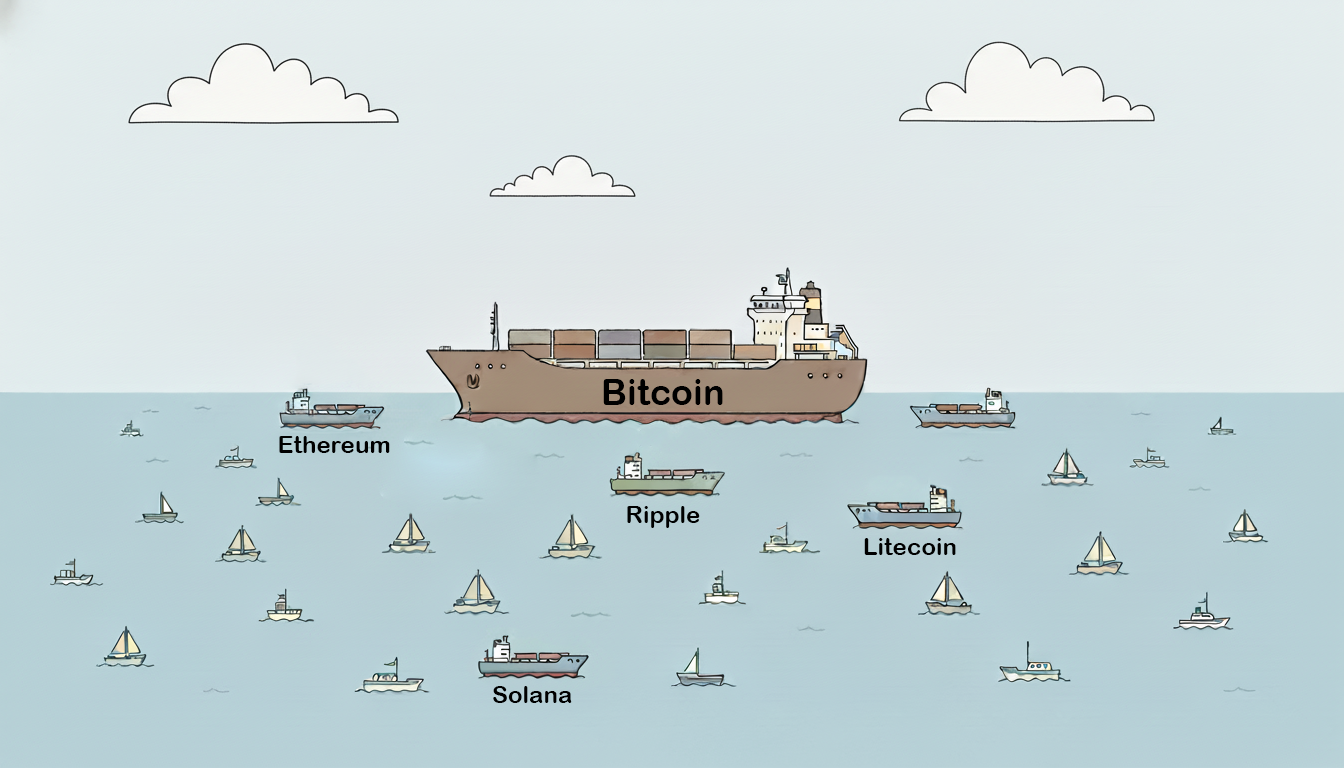
As the market leader, Bitcoin is the default entry point for most people entering crypto. When someone decides to buy cryptocurrency for the first time, they’re overwhelmingly likely to start with Bitcoin. So as the overall market expands, Bitcoin benefits disproportionately from that expansion.
Put those together and you have a core thesis: as long as it’s plausible and likely that crypto adoption as a whole continues to grow and Bitcoin stays the market leader, it’s a pretty good bet. You HODL (crypto slang for “hold on for dear life”).
What’s just as important here is what falls away. You don’t need to predict regulatory changes across fifty jurisdictions. You don’t need to track Ethereum’s technical roadmap. You don’t need opinions on every new DeFi protocol. You don’t even have to know what any of that means. Because none of it touches your thesis. You monitor two things: Is crypto adoption still growing? Is Bitcoin still the leader? If either changes, you reevaluate. Until then, daily price swings and hot takes are noise.
Again, this is not investment advice. It’s just to illustrate a thinking pattern, one that applies to more than business and finance.
How One Question Can Clarify Even the Most Complex Decisions
Unlike Bitcoin, marriage isn’t just overwhelmingly complex – it’s infinitely complex! 😉
I jest, but not really; there are daily conflicts, personality differences, financial stress, parenting disagreements, different communication styles, changing life stages, and so on. A strategist could easily get lost in the details and endlessly analyze every argument, every incompatibility, every frustration. There isn’t an algorithm powerful enough to weigh the impact of each little variable on a marriage. (Not to mention how utterly unromantic that is.)
But you can apply a simple core thesis. “Is my life fundamentally better with my partner than without? As long as the answer is yes, I don’t have to sweat the details.” It’s one question. Is your life – not isolated moments, but your actual life as a whole – better with this person? Do they make you more capable, more grounded, more yourself? If yes, you’re good.
And again, look at what falls away.
The argument about who does laundry doesn’t matter. How they load the dishwasher doesn’t matter. The personality trait that sometimes annoys you doesn’t matter. The night you wanted Thai and they wanted Italian doesn’t matter. None of that touches the thesis. It’s not a signal the marriage is failing. It’s the texture of two humans sharing space. And as long as the foundational answer is yes, the friction is just noise.
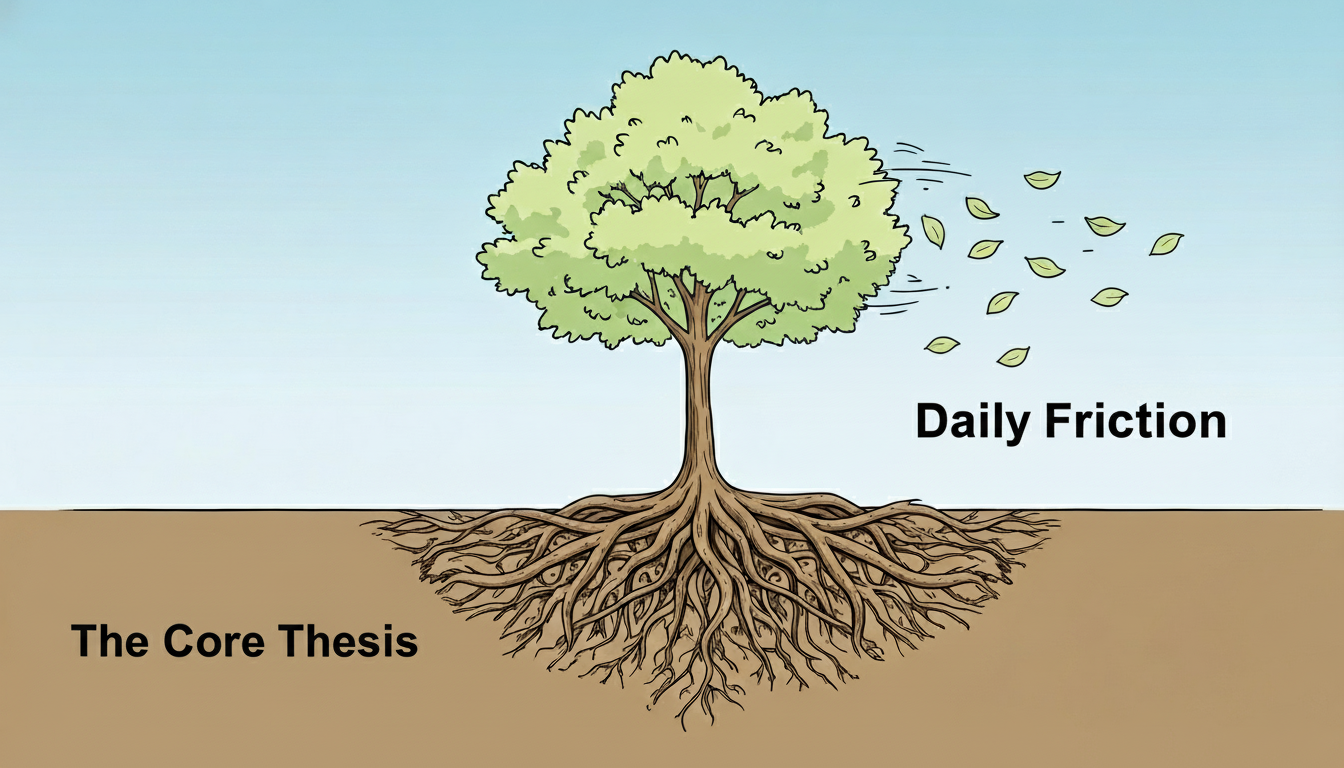
When does it matter? When the answer shifts. When your life is actually worse with your partner than without, then you have a real decision to make. Until then, daily conflicts don’t require decisions. They require perspective.
There will still be conflicts and disagreements. But you’re not constantly second-guessing whether you made the right decision. Because you have a clear standard that actually matters instead of being destabilized by every conflict that doesn’t.
Obviously, this is not relationship advice.
Why Defining What Matters Creates Freedom
It’s important to recognize that a core thesis doesn’t eliminate complexity. You’re not pretending the world is simple. You know that it’s not.
But this can eliminate decision fatigue. By defining what matters, you give yourself the freedom to ignore everything that doesn’t touch the foundation.
You still see the complexity. You acknowledge it. You understand you’re operating with incomplete information and that intersecting trends could shift the landscape in ways you can’t predict. But you’ve defined the foundational condition that matters. And as long as that holds, you can move forward with conviction despite the uncertainty.
So you’re not becoming less sophisticated. You’re becoming more selective about what deserves your attention and consideration. The constraint – defining what matters – creates the freedom to ignore what doesn’t.
That’s the real work. Having the discipline to define what you believe matters most and trust that definition even when the noise gets loud. Even when new complexity emerges. Even when smart people are paying attention to things you’ve decided to ignore. You’re not pretending those things don’t exist. You’re saying they don’t touch your thesis, so they don’t require a decision from you.
How to Build Your Core Thesis
The goal of a core thesis isn’t to create a perfect checklist. It’s about finding the simplest questions that create clarity.
Here’s the process:
First, ask what actually matters. Not what’s interesting or measurable. What’s foundational? If this one thing is true, does everything else become manageable? If it’s not true, does everything else become irrelevant?
Second, make sure you can monitor it. You need to be able to check whether it’s still holding. Sometimes that’s a metric (”renewals above 80%”). Sometimes it’s a judgment call (”are things getting better or worse?”). Either way, you need to know when the foundation shifts.
And keep it simple. If you need eight variables, you’re overcomplicating it and just creating more noise.
For example, when COVID started spreading in early 2020, we had an in-person conference coming up. Nobody knew what was happening. The data was confusing and the interpretations were all over the place. We couldn’t predict where this was heading.
But we had to decide: hold the event or cancel?
I sat down with my leadership team and we asked two questions:
- Right now, would we be putting our students at risk? Yes. Greater than zero.
- Do we expect things to improve before the event? No. Even in the best case scenario, the numbers will keep rising for weeks.
That was it. As long as those two things were true, it meant we had to cancel. We didn’t need to predict the pandemic’s trajectory. We didn’t need perfect information. We just needed clarity on what mattered.
The ultimate test of a core thesis is whether you can state it in one sentence starting with “As long as…”?
For example, a weak thesis looks like, “As long as I’m learning and growing and the market is expanding and my team is engaged and revenue is increasing…” That’s a wish list, not a thesis.
A stronger thesis looks like, “As long as we’re not putting students at unnecessary risk, we move forward.” That’s a filter that tells you what to pay attention to and what to ignore.
Conviction Is Not the Same as Certainty
When I retired our product catalog, I didn’t do it with perfect confidence. But I did it with a clear thesis.
And I’ve been checking that thesis ever since. Is our new understanding actually better? Are we serving our audience more authentically? Is the market responding?
Those aren’t metrics I can track on a dashboard. They’re judgment calls. But they’re the right questions to keep asking.
So far, yes. But I’m not waiting for perfect confirmation. I’m checking whether the foundation still holds. That’s the difference between conviction and stubbornness.
Conviction is acting on what you believe matters. Stubbornness is refusing to update when the evidence changes.
This is how you act as the Strategist without drowning in the complexity you see. You acknowledge you’re operating with incomplete information. You accept that intersecting trends could shift the landscape in ways you can’t predict. But you’ve defined what matters. And as long as that holds, you move.
The One-Eyed King acts from partial sight and doesn’t know it. The paralyzed Strategist sees their partial sight and freezes. The Strategist with a thesis sees their partial sight, defines what they’re checking, and moves anyway. Instead of trying to predict the future, they choose what questions to ask and move forward with the clarity they have.
Core Takeaway
Seeing complexity clearly is not the same as knowing what to do. The strategist’s trap is having enough awareness to be paralyzed by it. A core thesis doesn’t eliminate uncertainty, but it defines the one foundational condition that matters, so everything else becomes noise you can safely ignore. That’s how you move forward with conviction when certainty isn’t available.
AI Curious is Danny Iny’s book on learning to think clearly with AI — not as a productivity tool, but as a genuine thinking partner. It’s available now on Amazon.
about author
Danny Iny
Danny Iny is the founder of Mirasee, a 6x best-selling author, and an entrepreneur who helps coaches, consultants, and experts build businesses that are both profitable and purpose-driven. He’s best known for showing people how to package their expertise into premium offers, attract the right clients, and grow thriving businesses that make a real impact.
Read more posts by Danny Iny