
How to Build an AI Strategy Without Chasing Every New Tool
 Danny Iny
AI is moving faster than anyone can keep up with. That’s not a reason to panic – it’s a reason to be strategic. The entrepreneurs who will come out ahead aren’t the ones chasing every new tool. They’re the ones who know which clock they’re on.
This Article Answers
- Why does AI feel so overwhelming to keep up with?
- What are the two biggest mistakes people make when responding to AI disruption?
- How much time should you actually spend learning new AI tools?
- How do you build a sustainable AI strategy without chasing the frontier?

There’s an interesting duality in a lot of my days.
I’ll start the day thinking about the emerging capabilities of artificial intelligence – things like agentic systems and vibe coding custom software. Capabilities that allow us to collapse days of work into minutes, and expand hours to accomplish what would have taken weeks. And just eighteen months ago, it would have all sounded like science fiction.
Then, later on the same day, I might hop on a Q&A call with some of our students. The first question: “Do I need a paid ChatGPT account?” The second: “Can I trust what it tells me?”
Same day. Different worlds.
This is exactly what the futurist William Gibson meant when he said the future is here, it’s just not evenly distributed. The frontier and the market keep drifting apart, and the gap is wide enough that the round trip from one to the other can feel deeply disorienting.
The Two Clocks Driving AI Anxiety – And How to Read Them
There are two clocks at play here, and much of the AI anxiety I encounter comes from accidentally reading the wrong clock.

One is the innovation clock. This is about what’s possible, and it moves exponentially. In 2022, the best AI models couldn’t reliably multiply seven by eight. By 2023, they could pass the bar exam. A year after that they were writing production code and explaining graduate-level science, and by the end of 2025 some of the most accomplished engineers in the world were saying they’d handed the bulk of their coding work over to AI. Then this February, new models showed up that made everything before them feel like a different era. All that in just three and a half years.
The other is the adoption clock, which is about changing behavior. This clock is constrained by things like trust, comfort, workflow integration, regulation, and habits. It moves socially, which is to say slowly – at whatever pace a single person can change the way they operate, slowed down further by however many other people have to sign off on the change.
The adoption clock moves slowly because it happens downstream of trust – and when the stakes are high, trust has to be built carefully, bit by bit. New technologies have to prove out across enough cases for people to feel safe using it where it really matters. Then workflows have to be rebuilt around the change, and regulators have to bless it.
Each of those steps takes as long as it takes, and the underlying capability getting faster has little effect on the pace. Take self-driving cars, for example. Sure, the technology has to be ready (and not just “almost ready”, as it has been for a while). But the technology isn’t the only bottleneck – passengers have to be comfortable with it, insurance companies have to figure out how they’ll handle it, and regulators have to allow it to happen. Technology moves at whatever pace it moves, but it’s still constrained by the layer of social acceptance, which builds at its own pace.
Which means you have more time than the hype suggests, and less time than doing nothing assumes.
Strategy lives in the gap. So does cash flow. A business stays viable by serving people where they are, not where the frontier says they should be. And the frontier, by definition, sits past where most people live. That’s what makes it the frontier.
Watching the Wrong Clock
Most people watch the innovation clock and assume the adoption clock is keeping up. They scramble to catch up to a market that has barely moved. The discourse makes a particular fear feel reasonable: that you might already be obsolete and not know it. The fear is built on a misread of the curve.
Confuse the clocks and you fall into one of two failure modes. They look like opposites. They come from the same mistake.
The first is what I’d call frontier addiction. The frontier addict watches the capability curve and feels they have to be at the edge of it, all the time. They’re researching constantly, switching tools every week, spending their days in demo videos and threads about whatever launched yesterday. It feels productive. Very little of it builds into anything.
A lot of what lives at the frontier is still half-built. That’s part of what makes it the frontier. Anyone who lives there spends their time on tools that are experimental, brittle, and probably going to be replaced inside a quarter. They learn a lot. The lessons mostly slide off. And while they’re learning them, the actual business – the work that serves paying customers right now – sits exactly where it was last month.
The other failure mode is learned helplessness. Someone in this mode watches that same capability curve and concludes there’s no point even trying. Things are just moving too fast right now, so better to wait for things to settle. Except that it never actually happens. And in the meantime, they keep doing what they were already doing in 2023.
Both responses are based in very understandable emotions. Accelerating this fast is disorienting, especially when you’re watching from a distance. But they’re still both choices to opt out of the work of building capability over time. One person looks busy. The other looks frozen. Either way, the compounding stops cold.
Why Rushing to Learn AI Tools Usually Backfires
When my daughter Priya used to get stuck on her math homework, it would fluster and stress her out. She would start rushing, and make sloppy mistakes – which led to more stress. A vicious cycle.
I would tell her the same thing every time. Slow down. Take a deep breath. Focus on the best next step in front of you right now. Slow is smooth, and smooth is fast. It’s a line that comes from the military, but it applies everywhere.
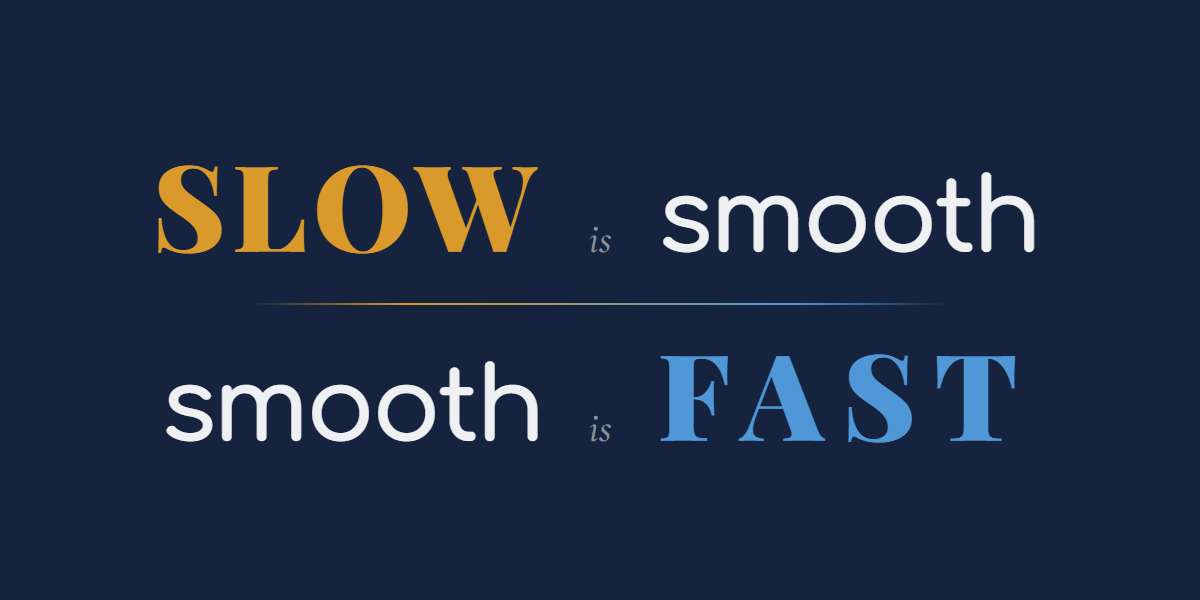
Acceleration creates urgency that scatters your attention. You end up with shallow learning, half-finished projects, and a graveyard of tools you set up over a weekend and forgot by the next. Three months in, you’ve got little to show for the panic, and you’re three months further behind the curve that scared you.
In my experience, the people most spun out about the speed of AI are the ones doing the least practical work to deepen their understanding. The hours they spend anxious about what they’re missing are hours they could spend learning something concrete. Will they figure it all out in an afternoon? Obviously not. Will they know more than they knew yesterday? Yeah.
Slow is smooth, and smooth is fast.
All You Need Is to Stay Ahead of Your Market
There’s an old story about two friends walking in the woods. A brown bear shows up. One of them bends down and starts tying his shoes. The other says, “What are you doing? There’s no way you can outrun a brown bear.” The first one says, “I don’t have to outrun the bear. I just have to outrun you.”
Now, Bond villain-esque ethics and expository impulses notwithstanding, the story teaches us that you don’t need to be on the frontier to win. You just need to be meaningfully ahead of the people you serve, and the people against whom you’re competing. That’s it. The advantage is relative to other people, not the absolute capabilities of the technology. The contest isn’t happening on the frontier.
The frontier discourse implicitly tells you that the gap between you and the cutting edge is what matters. That’s the wrong gap to pay attention to. The gap between you and the people you serve is what matters. And in most fields, in most markets, those people are way behind where the loudest voices say they should be.
This is the part that often comes as a relief. Your competition is also stuck back here with you, or even further behind – for now.
How Much Time Should You Actually Spend on AI?
So if you shouldn’t be chasing the frontier, what should you do?
The system I’ve ended up with comes down to two things that run in parallel. You build for where the market is. You train for where the frontier is going.
The bulk of my week goes to the present – to the things that improve outcomes for the people I’m working with right now. Real problems, solved with tools that already exist and work.
A small slice of my time (a couple of hours a week, give or take) goes to ambient scanning. I read, listen, watch what’s happening at the edges. I let releases and announcements drift past. The goal is a thin layer of awareness about what’s in the air, more or less.
Occasionally something hits a live wire. I see a new capability, and I can feel that it would matter for what I’m doing right now. Not someday. Now. That’s when I escalate. I spend a few days going deeper, sometimes longer, sometimes pulling my team in. The depth is justified because the signal was real.
The trigger separates this from frontier addiction. Curiosity has me digging in because something connects to a real problem on my desk that I’m trying to solve. Fear would have me digging in because everyone else seems excited about it on LinkedIn, and the worst thing imaginable is being the one who missed the boat. Curiosity escalates when something matters for the specific work in front of me. Fear escalates because that’s always what fear does if you let it.
The two have different textures. Curiosity-pulled exploration has a thread. You’re following a question. Fear-pushed exploration jumps around. New tool, new framework, new threat, new opportunity, with little of it staying long enough to build into anything.
None of this is an argument against the frontier. It’s an argument against the panic the frontier produces, and against mistaking attention for progress. Pulled by curiosity, not driven by fear.
Why Composure Is the Real AI Strategy
I’ve lived through several waves like this. Platform shifts that made certain businesses impossible overnight. New channels that threaten old models. COVID. Each time, the pattern held. The people who panicked spent the cycle running between failure modes. The people who stayed composed kept compounding through the disruption.
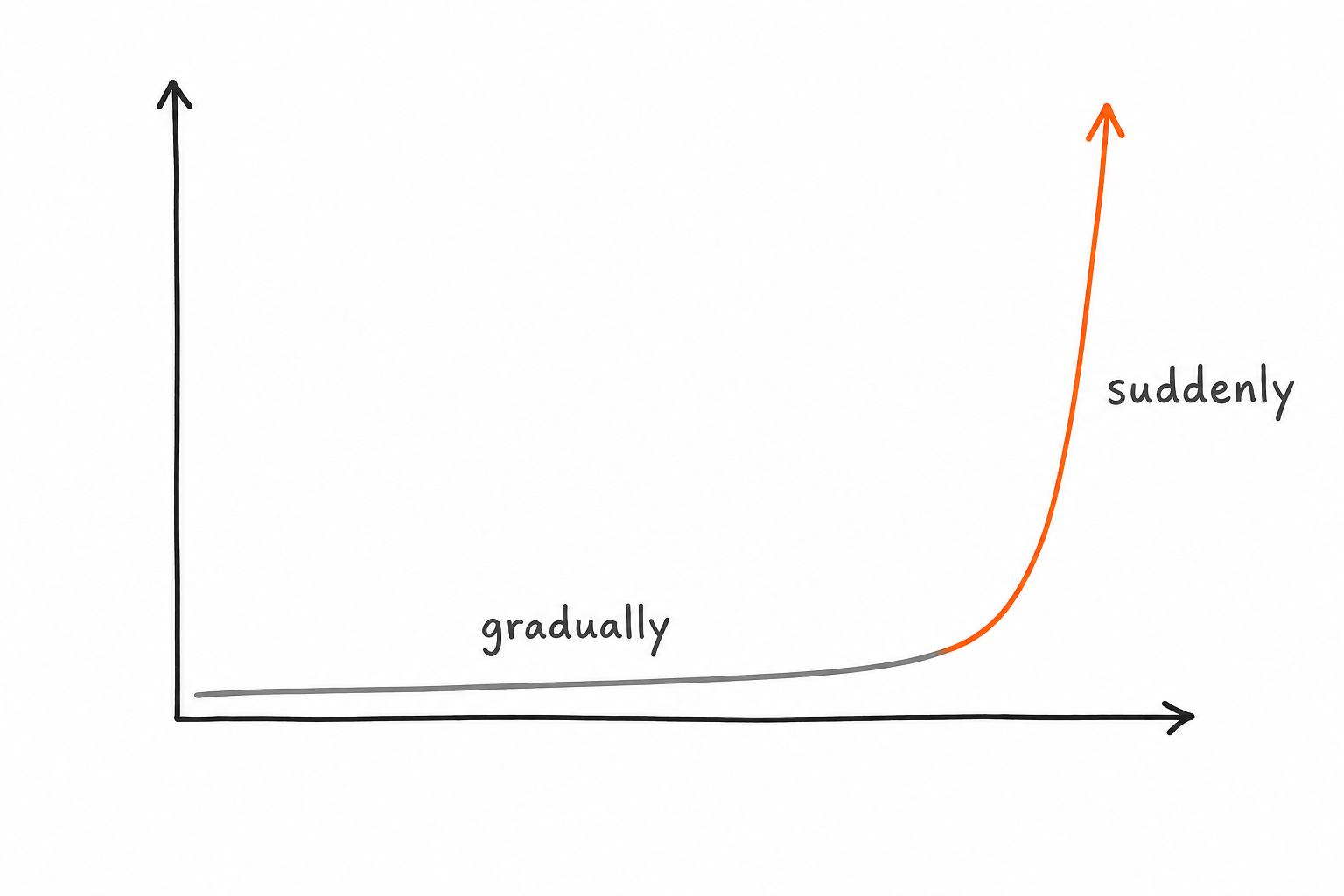
Hemingway wrote that bankruptcy happens two ways: gradually, then suddenly. Market shifts work the same way. For a while, nothing seems to change. Your offers still sell. Your clients still show up. The numbers look okay. That’s the gradually phase. Then one quarter, things shift, not because anything dramatic happened, but because enough small changes accumulated that the old model stopped working the way it used to.
In exponential times, composure isn’t complacency. It’s strategy. And strategy, in a world where capability moves faster than adoption, mostly comes down to temporal calibration. You have to know which clock you’re on, and act accordingly.
That’s why the morning of agents and the afternoon of “do I need a paid account” belong on the same calendar. Those are two pieces of the same week, not two worlds I’m caught between. The morning is the scanning. The afternoon is the knitting. Keep an eye on each clock, and they stop competing for the same nervous system.
You don’t have to be on the frontier. You need to be meaningfully ahead of the people you serve, and to keep widening that gap a little at a time. When something real shows up, you escalate. The rest is composure, and the next step in front of you.
The future doesn’t reward the fastest. It rewards the ones who are still standing.
Core Takeaway
AI moves on two clocks — the innovation clock and the adoption clock — and most anxiety comes from confusing the two. The innovation clock moves exponentially. The adoption clock moves socially, which means slowly. Strategy lives in the gap between them.
You don’t need to be on the frontier. Instead, you need to be meaningfully ahead of the people you serve, and to keep widening that gap a little at a time. When everything feels like it’s accelerating, composure isn’t complacency. It’s strategy.
AI Curious is Danny Iny’s book on learning to think clearly with AI — not as a productivity tool, but as a genuine thinking partner. It’s available now on Amazon.
about author
Danny Iny
Danny Iny is the founder of Mirasee, a 6x best-selling author, and an entrepreneur who helps coaches, consultants, and experts build businesses that are both profitable and purpose-driven. He’s best known for showing people how to package their expertise into premium offers, attract the right clients, and grow thriving businesses that make a real impact.
Read more posts by Danny Iny