
How AI Is Changing Online Courses (And What Course Creators Must Do Next)
 Danny Iny
AI has made information abundant, instant, and cheap. But it hasn’t eliminated the need for human guidance. Instead, it’s clarified which course creators will thrive and which business models are quickly becoming obsolete.
This Article Answers
- How is AI changing the online course industry?
- Are self-paced online courses still worth selling?
- What should course creators sell if information is now free?
- What kind of business model works best in the AI era?

In 1975, an engineer at Kodak invented the digital camera.
Kodak’s leadership saw it, understood its potential, and then buried it. Not because they failed to see the future. They saw it clearly. They buried it because they were making too much money selling film.
What most people miss about the Kodak story is that the choice wasn’t really between film cameras and digital cameras. It was between two entirely different business models. Kodak’s real money came from selling film, developing chemicals, and photo processing services. Their entire ecosystem was built around the recurring revenue of film.
So the digital camera wasn’t merely a product innovation. It disrupted the entire ecosystem. Digital eliminated the need for film, processing, and prints. It got rid of entire categories of business. But it also expanded the role of photography in society.
It enabled instant sharing, unlimited storage, and eventually, entirely new platforms like Instagram that Kodak never imagined. The shift from film to digital wasn’t really about cameras. It was about reimagining what a photography company could be.
They could have evolved from a film company to an imaging company. Instead, they clung to their old business model until it was too late. By the time they admitted the truth, other companies had already claimed the future.

The expert industry is facing its Kodak moment right now.
Artificial Intelligence (AI) fundamentally changes how value is created and delivered in education. Many course creators see what’s happening but are desperately trying to protect their existing model, just like Kodak did with film. They’re adding AI tools to their courses in superficial ways to not seem behind.
That’s not enough, though, because the business model itself needs to change.
Why Selling Information No Longer Works
The era of selling information is over. That’s already happened, not a future prediction.
Your perfectly organized module on “How to Write Grant Applications” becomes worthless when anyone can get instant, personalized advice from AI. The same goes for your templates, your frameworks, and most of your video lectures. AI does information transfer better, faster, and cheaper than any course ever could.
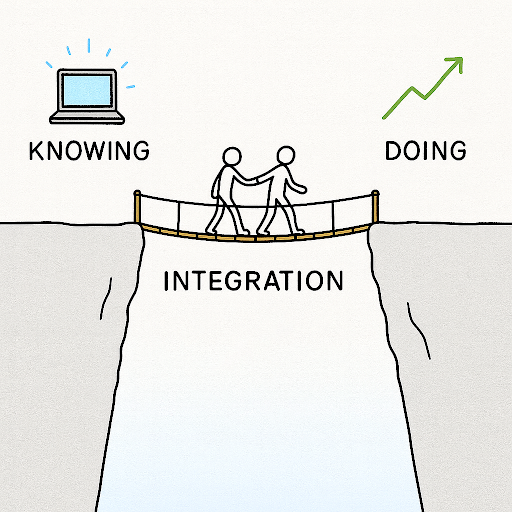
But while AI has commoditized information, it has also clarified what really matters. The messy, complex work of helping humans actually change still requires humans. So you’re not selling information anymore. You’re selling integration.
Integration is the bridge between knowing and doing. It’s what helps someone take generic best practices and apply them to their specific situation, with their particular constraints, their unique context, and their actual goals.
AI can tell you the five ways to price your services, but it can’t sit with you while you work through why you keep underpricing. AI can give you a business plan in seconds, but it can’t help you navigate the tradeoffs between what you think you should want and what you actually want.
This is the interstitial role – bridging the gap between what AI provides (infinite information) and what humans need (wisdom, context, and support through actual change).
The New Business Model for Course Creators
The business model that thrives in the AI era looks fundamentally different from traditional online courses. It’s built on five core pillars that leverage what remains uniquely human.
1. Bridging the Gap Between Knowing and Doing
The old model was about transfer – moving information from the expert’s head to the student’s head. Watch the videos, download the worksheets, follow the steps, get the result.
The new model focuses on transformation through integration. You’re not teaching the steps anymore. Instead, you’re helping people navigate the gap between understanding something intellectually and actually being able to do it in their business.
Your value comes from knowing why step 3 always trips people up, even though it looks simple on paper. You recognize when someone needs to skip step 4 entirely because of their unique situation. You can see the pattern when someone is unconsciously sabotaging their own progress and help them work through it.
However, integration goes deeper than implementation.
It’s synthesis – helping someone see how all the pieces fit together. AI can explain email marketing, social media strategy, and sales funnels separately. But it can’t help someone understand how these elements should work together in their specific business, with their specific audience, given their specific strengths and constraints.
Think about it like learning to cook. AI gives you access to every cookbook ever written, every technique ever documented. But that doesn’t mean you can cook. You need someone who can help you understand not just how to follow a recipe, but when to deviate from it, how to adjust for what’s in season, and why certain flavor combinations work for your particular style.
That’s integration, and it requires human judgment, experience, and presence.
2. Containers Are Replacing Self-Paced Courses
The self-paced online course is dying. Buy it whenever, start it whenever, finish it… probably never. This model made sense when information was scarce. Now that information is infinite and free, self-paced courses can’t compete.
What’s replacing them are containers: time-bounded, cohort-powered spaces that provide structure, momentum, and connection. But a container is more than just a schedule. It’s a held space where transformation happens.
A container creates the conditions where people actually do the work, so that transformation actually happens. You have a clear beginning and end that creates urgency – not artificial scarcity, but genuine momentum. Everyone moves through the material together, creating social momentum that pulls people forward even when they want to quit. Live touchpoints create real accountability because people know others are expecting them to show up. The facilitator is actively present in the process, not just available if someone has a question.
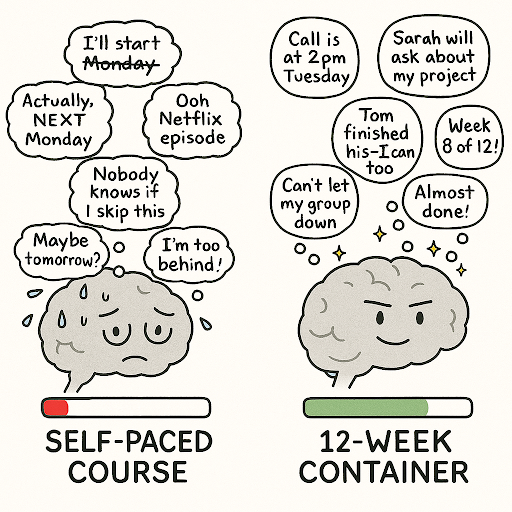
The magic happens because containers solve the real problem. Access to information was never the true bottleneck. The bottleneck was creating conditions where people actually do the work, push through resistance, and maintain momentum long enough to see results.
When your cohort is struggling with the same challenge you are, isolation disappears. The energy becomes collective when everyone is working on their projects at the same time. And when you know that next week’s call will ask about this week’s commitment, you’re more likely to follow through.
AI can’t create any of this. It can’t generate the energy of a group breakthrough or the peer pressure of not wanting to let your cohort down. It can’t facilitate the moment when someone else’s vulnerability gives you permission to share your own struggle.
This is why platforms built for cohort-based learning – like Ruzuku – are seeing renewed interest. They’re designed from the ground up for the container model: timed content delivery, built-in discussions, and group accountability structures that self-paced tools simply weren’t built for.
3. Your Perspective Matters More Than Best Practices
Every business framework can be found on Google. Every tactical approach has been written about a thousand times. So if you’re curating best practices, you’re already obsolete.
The good news is that your proprietary perspective – your unique way of seeing the problem – remains irreplaceable. This goes beyond being clever or original. It’s about codifying the wisdom you’ve earned through experience. It’s leveraging the mental models you’ve developed and the patterns you’ve learned to recognize.
Because AI can aggregate every article about Facebook ads ever written. But it hasn’t sat across from 500 business owners and noticed that 90% of them are solving the wrong problem with their ads. AI can explain pricing theory perfectly, but it hasn’t watched 100 entrepreneurs systematically undervalue themselves in the same specific way and developed a framework to help them break that pattern.
Your intellectual property is no longer the information you’ve collected. It’s the lens through which you see the world and the frameworks you’ve developed to help others see it too.
4. High-Agency Learners Will Be the New Market
The market is splitting into two segments, and trying to serve both will destroy your business.
The first segment wants magic. They want AI to do everything for them. They bounce from tool to tool, course to course, always looking for the solution that will finally fix their problems without requiring them to change. You should gracefully let this group go. They’ll be better served by AI and DFY agencies anyway.
The second segment understands that information is just the starting point. They’re looking for leverage, not magic bullets. They want guidance through the difficult parts, not promises that there won’t be any difficult parts. These high-agency learners are your people now.
Note that this shift requires you to fundamentally change how you position and market. Stop promising that your course makes things easy. Start promising that it makes things possible. Stop attracting people who want to avoid the work. Start attracting people who want support in doing the work.
Meanwhile, the people who want transformation will pay premium prices for genuine support through their journey. They’ll do the work, get the results, and become your best advocates.
5. The Shift From Expert to Clarity Partner
The traditional expert model was built on having the answers. You were the oracle. People came to you for the secret knowledge, the hidden tactics, the insider information. That model is dead because AI is now the ultimate oracle. It provides infinite answers, instantly available, perfectly personalized. (Being the oracle is tiring anyway, so this is good news.)
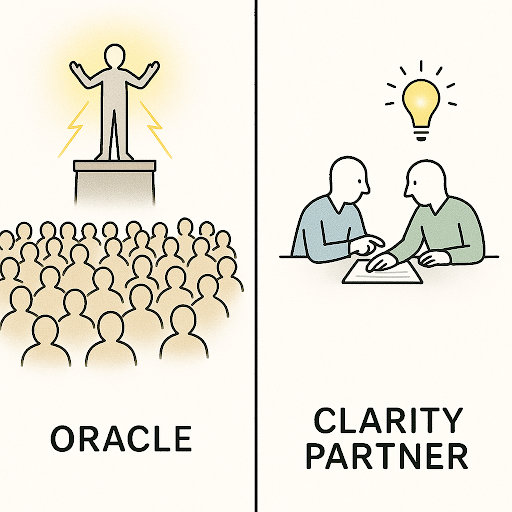
Your new role is as a Clarity Partner. You help people see which questions actually matter. You reflect back their patterns. You challenge their assumptions. You help them distinguish between what feels urgent and what’s actually important.
This requires setting aside the need to be the smartest person in the room. It means becoming comfortable saying “I don’t know, but let’s figure it out together.” It means seeing your expertise not as a collection of answers but as a capacity to guide discovery.
AI can answer any question instantly. But it can’t tell you that you’re asking the wrong question. It can’t notice that you keep avoiding the real issue. It can’t see that your problem isn’t tactical, it’s that you don’t actually believe you deserve success.
That means the Clarity Partner is even more valuable than being an oracle because everyone has access to the same AI oracles. But not everyone has access to someone who can see their blind spots and recognize their patterns. They don’t know someone who will help them understand not just what to do but why they’re not doing it… and them hold them accountable to actually do it.
What This Means for Your Business Model
These five pillars require fundamental changes to how courses are structured, delivered, sold, and measured.
Integration takes time, so your entire timeline shifts. Instead of 30-day sprints, you need 90-day transformations. Instead of one-time courses, you want to lean toward 6-month containers that support people through the full arc of change. Instead of cramming content into short timelines, you’re creating space for concepts to marinate and for real change to happen.
Fortunately, this deeper work commands premium pricing. The market will pay $5,000 for genuine human guidance more readily than $500 for another information product. And price is also a filter for commitment. People who invest significantly are more likely to do the work, show up to calls, and push through resistance. The investment itself becomes part of the transformation.
That higher price allows you to create intimate, powerful containers. Instead of courses with 1,000 students who never interact, you want programs with 20 participants who actually know each other’s names, stories, and struggles. When someone doesn’t show up, it’s noticed. When someone has a breakthrough, everyone celebrates.
Your success metrics change too. Completion rates and satisfaction scores matter less than actual transformation. Did they implement? Did their business change? Did they become who they wanted to become?
Finally, the delivery method shifts fundamentally. Live sessions become the core experience, not a bonus. Pre-recorded content becomes homework, not the main event. Human touchpoints aren’t merely support for the product… they are the product itself. And the real work happens in the live sessions where people get unstuck, where patterns get revealed, where breakthroughs occur.
The Future of Online Courses in the Age of AI
What’s really interesting is that these shifts were already in motion. For years the online course industry has been struggling with low completion rates and the commodification of information-only courses. The most successful course creators recently had already begun evolving – running cohorts and raising prices to provide deeper support.
So AI didn’t create all these shifts. But it accelerated them and made them impossible to ignore. It drew a bright line between information and what remains uniquely human: the messy work of transformation; skilled facilitation of groups; pattern recognition from lived experience; and the ability to hold space for someone’s journey.
The market has already made its choice. Information products are dying while transformation experiences hold their value. The educators who recognize this shift and adapt their business models accordingly will thrive. Those who cling to the old model, trying to protect their “film business” while the world goes digital, will struggle to survive.
The playbook is clear because the market already wrote it. AI just made it required reading.
Core Takeaway
AI didn’t kill education. It killed the business model of selling information.
The course creators who thrive in the next era won’t be the ones who “add AI” to their content.
They’ll be the ones who redesign their business around what AI can’t replace: integration, human judgment, group transformation, and high-touch containers that help people actually change.
Want to go deeper on what it really takes to thrive in the AI era? Inside the free AI Strategist Quickstart course, we’ll help you use AI to sharpen your thinking, clarify your strategy, and build a business model that’s designed for transformation, not just information.
about author
Danny Iny
Danny Iny is the founder of Mirasee, a 6x best-selling author, and an entrepreneur who helps coaches, consultants, and experts build businesses that are both profitable and purpose-driven. He’s best known for showing people how to package their expertise into premium offers, attract the right clients, and grow thriving businesses that make a real impact.
Read more posts by Danny Iny