
Building a Longer Table: How AI Is Changing the Economics of Expertise
 Danny Iny
AI isn’t just making expertise businesses more efficient. It’s changing how experts build trust, deliver transformation, and structure their entire business model.
This Article Answers
- How is AI changing the business model for coaches and consultants?
- Is the traditional value ladder still the best way to sell expertise?
- Why does AI make generosity more economically viable?
- What replaces the traditional value ladder?

“If you have many blessings, use them to build a longer table, not a taller fence.”
I first heard that line about a year ago. I love the sentiment, and I love that it is shared by a lot of people in the world of coaching, consulting, and online education. We do this work because we wanted to help people, and if we could do that for more people, we would.
But generosity has always had a practical constraint: economics.
To really help someone, you have to understand their situation, find what’s holding them back, and walk them to the next real step. That all takes energy, effort, and time – all of which are in short supply. So they get rationed. You give away what you can, and charge for the rest.
That’s why the blessings have to come first – extending the table is only practical once you can afford to feed the people who will sit by it. Most people never get to the point of being able to fund the generosity that they truly aspire to. You’d help everyone who walked in if you could, but the math says no.
Except that now, this is all starting to change.
Why AI Is Restructuring the Expert Economy
If you remember anything from economics class, it’s probably that markets find equilibrium where supply and demand intersect. That’s the basic version. But it’s incomplete.
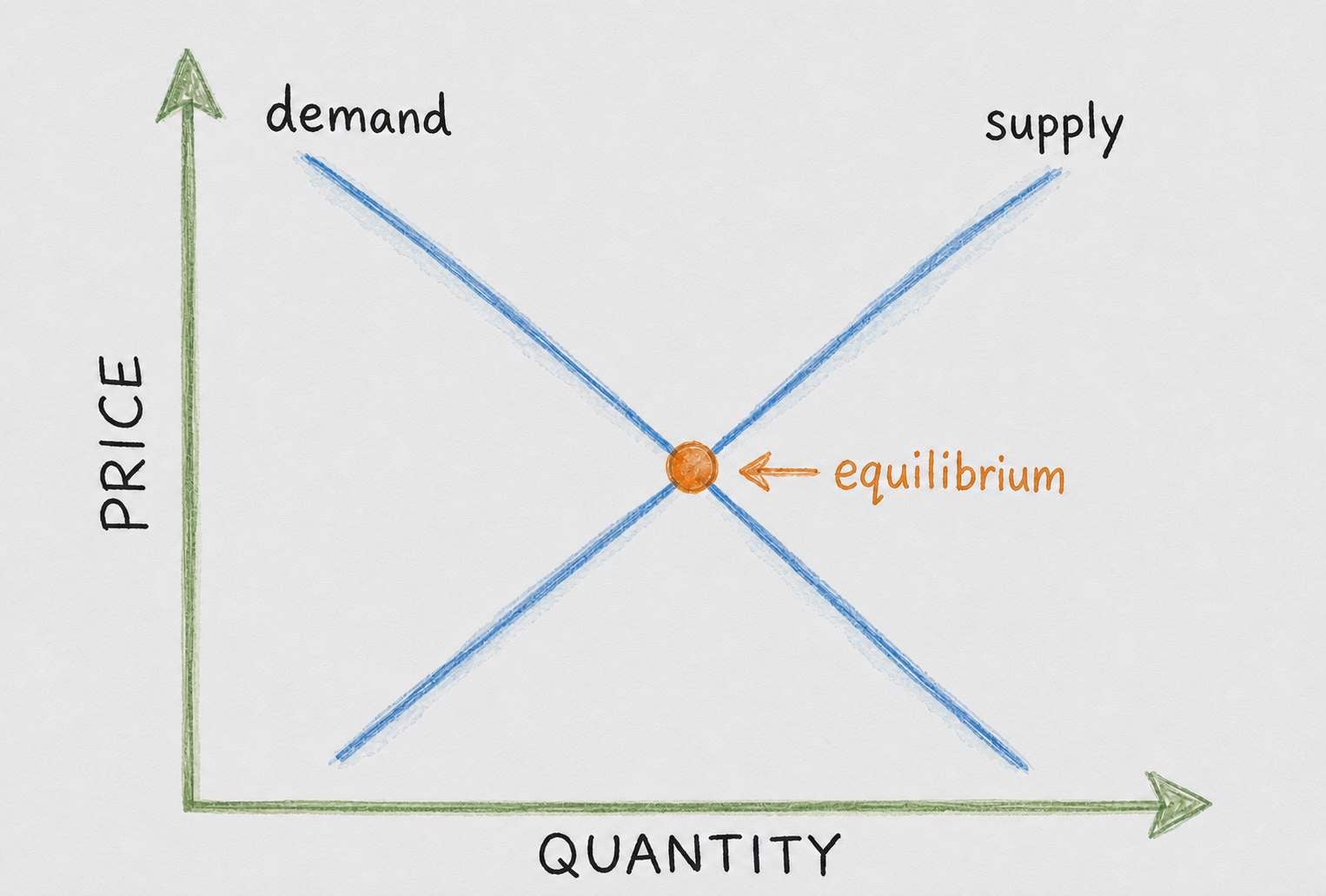
Markets find equilibrium where supply and demand intersect with reasonable profit.
That addition is what makes markets self-correct. If profits are excessive, entrepreneurs see the opportunity and enter the market, which increases supply and drives prices down. That’s what Jeff Bezos meant when he said that “your margin is my opportunity.”
It works the other way, too. If profits are insufficient, players leave because the effort isn’t worth it, which reduces supply and drives prices up. Free markets are always moving toward that balance point. Often slowly, and with a lot of confusion along the way, but they get there.
You can see the dynamic most clearly when new capabilities emerge. The first generation of anything is expensive to build and deliver. But capabilities improve over time, tooling gets better, and processes mature. The cost of delivering the same outcome drops.
Prices, though, don’t drop at the same speed. If demand is steady and competition hasn’t caught up, you keep collecting the expanding margin. That’s how markets behave when they’re out of equilibrium. The gap between what it costs you to deliver and what the market will pay keeps growing until something corrects it. Either new entrants compete the price down, or you disrupt yourself before they do.
When I first started in the online education space, the standard was roughly $2,000 for a “course” that was really just a collection of videos in a membership site. The cost to deliver was a fraction of that, and the excessive margin was my opportunity. So I charged less and delivered more. It wasn’t genius, just basic arithmetic. The margin was sitting right there.
That same pattern is playing out again right now in the creator economy. Except this time, the cost of delivery isn’t falling gradually. AI has dropped it by an order of magnitude. And when costs drop that fast, markets don’t just adjust. They restructure entirely.
The Real Purpose of the Traditional Value Ladder
The traditional value ladder you’ve probably seen goes something like this: free leads to inexpensive, which leads to a $1,000 to $3,000 course or coaching program, which leads to a high or ultra-premium offer. It’s been the standard architecture for over a decade.
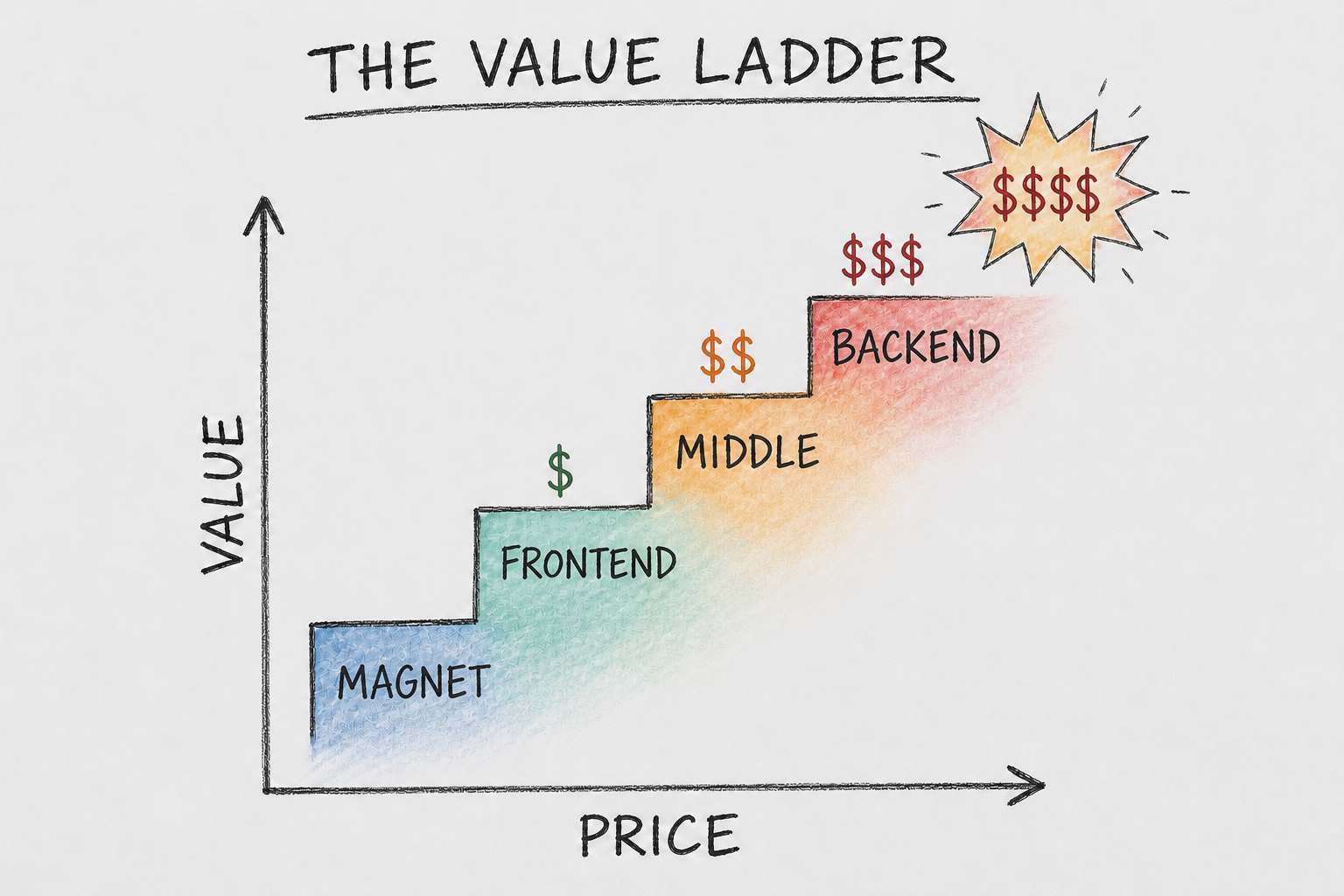
The whole ladder is built to move people toward the top, because the top is where the real transformation happens. This is true for two reasons. First, the clients up there are the most serious and committed – they’re the ones who do the work and see it through. And the top is the only tier with the margin to fund the coaching and feedback and hands-on support a real result takes. The top is the destination. Everything underneath it exists to get people there.
So why not just serve the top? If that’s where the transformation happens, why bother with the rungs below at all?
Because almost nobody starts at the top. Before someone will make that kind of investment, three things have to be true. First, they have to believe the opportunity is real and achievable. Second, that they can pull it off. And third, that you’re the one who can get them there. Building those three beliefs has always taken enormous time and energy. Webinars, email sequences, discovery calls, the lower-priced programs that let someone sample your work before betting big on it. That is what the middle was actually for. Not funding the labor of delivery so much as doing the slow work of building belief, until someone was finally ready for the top.
Think about what that $2,000 program actually bought someone. Access to a group coaching program with weekly calls. Email support between sessions. Maybe a diagnostic that helped them see where they were stuck. It was valuable, assuming the creator knew what they were doing. And every hour a coach spent with one person was an hour they couldn’t spend with anyone else. That’s the economic floor that set the price.
If you could have handed out those middle rungs for free and walked more people all the way to the top, you would have. Of course you would, that’s the whole point. But you couldn’t, because building belief at that depth cost too much to give away. The ladder was never anyone’s ideal. It was the best you could do given the economics.
I’ve written previously about how AI is reshaping the landscape of online courses and about the structural pressures on offer-market fit. Those pieces examined parts of this puzzle individually. But the economics that held the entire structure together are changing.
How AI Is Replacing the Middle of the Value Ladder
Two forces have been converging over the last couple of years.
The first is market maturation. The industry has moved past innovators and early adopters into mainstream buyers who are, understandably, more skeptical. They’ve seen too many promises underdelivered. Trust is harder to earn. A $2,000 bet on “maybe this will help” feels riskier than it used to.
But maturation alone doesn’t restructure an industry. AI is what pushed it past the tipping point.
And I’m not talking about content production. That was always cheap. The expensive part was personalization. The diagnostics, the guided feedback, the implementation support. The work that used to mean a human being sitting with someone for an hour, understanding their situation and figuring out the right next step. That work can now be delivered at scale, for a fraction of what it used to cost.
Say you coach people who want to leave a corporate job and go out on their own, and instead of a downloadable checklist you’ve built a short AI-powered experience they can talk to. Someone shows up one evening, half-skeptical, and answers its questions. She mentions she’s a project manager, that she’s got about eight months of savings, and, almost as an aside, that two former colleagues keep paying her on the side to rescue their stalled launches.
A few questions later it connects those facts for her. She’s been paid for this twice already, by people who came looking for her, and she still files it under favors. The runway was never the real question. The proof was already there in her own story. Then it hands her one move for the week: go back to those two people, ask each for a referral, and name a real rate when she does. She trusts you a little more than she did an hour ago, and it cost you next to nothing, because you were never in the room.
And yet AI is the reason trust is so scarce in the first place. Anyone can generate infinite plausible content, and once everyone can, none of it counts for much. So how is a free AI experience supposed to earn trust, when AI is the thing that devalued trust to begin with?
AI flooded the zone with content, and content was never the same thing as trust. As Stephen Covey put it, trust is built over time, through repeated demonstrations of character and competence. Content was only ever a cheap way to carry those demonstrations, and now that anyone can produce an endless supply of it, it carries almost nothing. But the demonstration underneath still works as well as it ever did. Showing someone, concretely, that you understand their situation and can move them forward. That kind of proof was always expensive, so you kept it behind the paywall. You couldn’t afford to prove yourself to people who hadn’t paid you yet.
AI changes the cost of that proof. You can now run a real demonstration, built for one person’s situation, for someone who hasn’t paid you a dollar – evidence that you understand this person and can help them. Volume eroded trust. Specificity rebuilds it. Build that into the front of your business and it runs at the scale of the internet instead of the scale of your calendar. That’s not a lead magnet. It’s a trust engine.
That is the job the middle of the ladder used to do. The webinars and the $2,000 programs built belief by spending human hours on it. Now the front end can build the same belief for a fraction of the cost, which means the middle has less and less reason to exist.
Stand back and the ladder has changed shape. The rungs in the middle thin out, and the weight collects at the two ends. It looks more like a barbell. On one end, generous, near-free experiences built to earn trust and show what you can do. On the other, premium, deeply relational work that runs on human judgment, accountability, and real relationships. The middle compresses. It hasn’t failed. The model just doesn’t lean on it the way it used to.
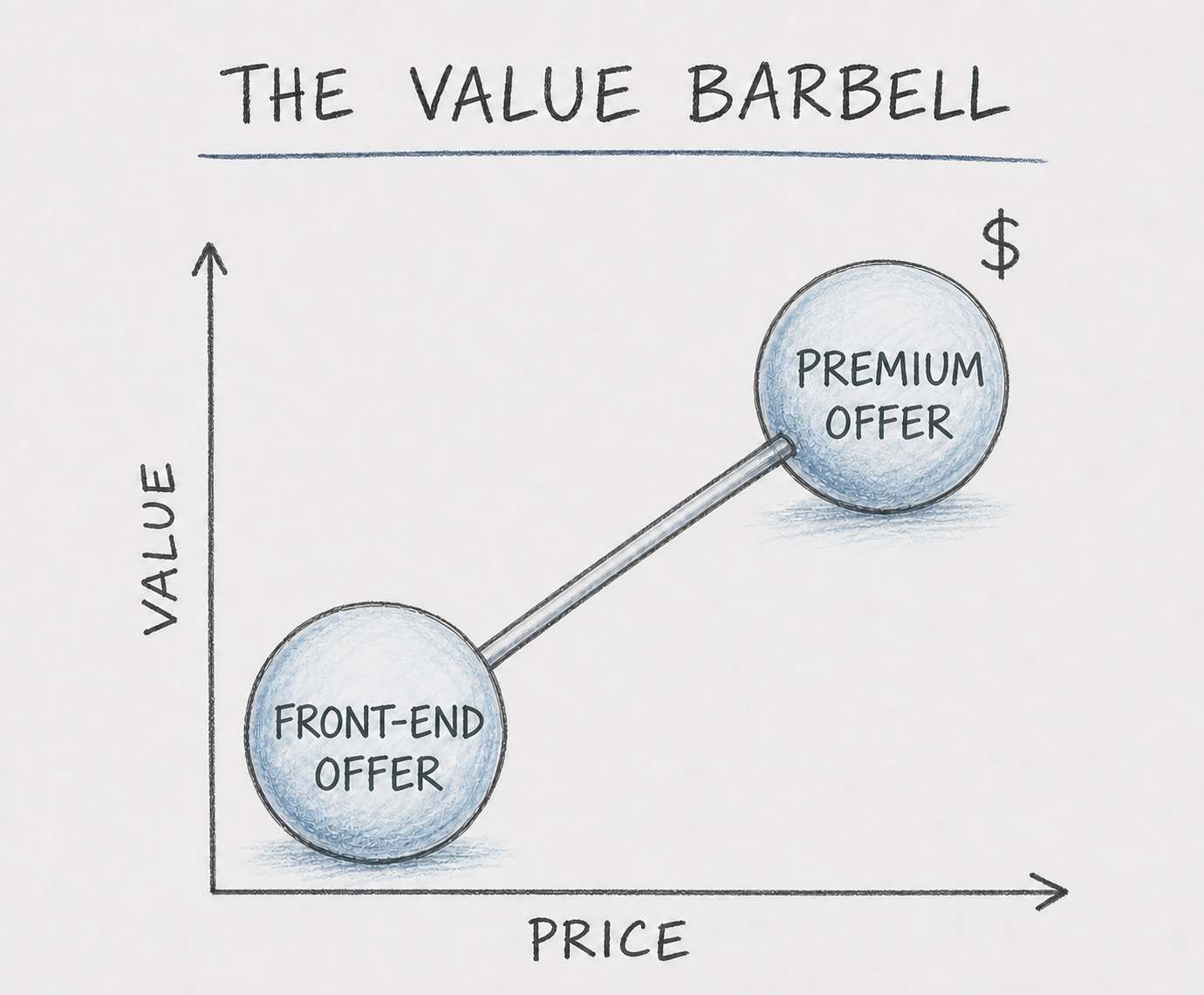
This isn’t happening at the same pace everywhere. Some markets are further along than others. Some creators are already operating on the barbell while others are still building traditional ladders that work fine for now. But the direction is clear, and the economics tilt everyone the same way.
Why AI Makes Generosity Economically Viable
For most of the history of expertise businesses, helping people at scale has hit a hard financial ceiling. You could believe in the longer table with everything you had, and every seat at it still cost real money to fill. The math set the limit, every time. AI is the first thing that genuinely lifts that ceiling, which is exciting and a little disorienting at the same time.
You can now deliver far more help to far more people, at much lower cost. The guidance, diagnostics, personalization, and implementation support that used to require charging hundreds or thousands of dollars can increasingly be offered for a fraction of the price.
AI is making generosity economically viable.
That generosity works two ways at once. It genuinely helps the person on the receiving end, whether or not they ever buy. And it’s an invitation. The free side is where someone first feels what it’s like to think alongside you and make real progress, and some of them, having felt it, will want to go further. They cross to the premium end on their own. The same generosity that helps people for free is also what fills the premium end. The open-handed left side feeds the deep, relational right.
On the premium side, none of the value of deep human work has diminished. Judgment, accountability, high-stakes decision support, reading a room, the pattern recognition that only comes from years of having done the thing. AI can support all of it, and it should. But it can’t stand in for a person who has been there. The premium container gets smaller, deeper, and more valuable.
Building for these economics isn’t simple. Reworking your offer architecture is real work, and the pull to just bolt AI onto the structure you already have is strong. That’s the common mistake, and a tempting one. The whole architecture of how you build trust and deliver transformation has to be rethought, not retrofitted.
And the payoff is real on both ends of the barbell, not just the premium one.
AI disruption is bigger than most of what we’ve seen before, but it’s still operating inside a market. And markets always move toward equilibrium with reasonable profit. We’re watching that adjustment play out in real time.
AI didn’t just make content cheaper. It made generosity economically viable, and for the first time the economics of expertise businesses are catching up to a philosophy many of us always wanted to live by. Build a longer table. You no longer need an abundance of blessings to do it. The cost of generosity just dropped, and the gate that kept the table short is finally coming off.
Core Takeaway
AI isn’t just lowering the cost of creating content. It’s lowering the cost of helping people. As personalization and guided support become dramatically more affordable, experts have an opportunity to rethink how they build trust, deliver transformation, and structure their businesses. The future belongs to those who use AI not simply to work faster, but to serve more people more generously.
If this article resonated with you, you’ll find many of these ideas explored more deeply in Danny’s book, AI Curious. It examines how AI is changing the way experts think, teach, and build their businesses – and how to use it as a genuine thinking partner, not just a productivity tool.
about author
Danny Iny
Danny Iny is the founder of Mirasee, a 6x best-selling author, and an entrepreneur who helps coaches, consultants, and experts build businesses that are both profitable and purpose-driven. He’s best known for showing people how to package their expertise into premium offers, attract the right clients, and grow thriving businesses that make a real impact.
Read more posts by Danny Iny